

Shepard Homeplace, Courtesy Historic Buckingham
The April issue of the Buckingham Beacon features my biographical sketch of William Gamaliel Shepard one of Buckingham County’s notable historians and writers. Here’s how it begins:
In the autumn of 1918, men across Buckingham County, between the ages of eighteen and forty-five were registering with the Local Selective Service Board, facing the possibility that they might soon head to France and the trenches. William Gamaliel Shepard was among them. Twenty-one years old, of medium build, William had light brown hair and eyes. A native Virginian, he lived near Guinea Mills and was a pretty typical registrant save one detail. He was “self-employed” and gave his occupation as “literature.” In a county filled with farmers, William aspired to be a writer. He was determined and fulfilled his promise. In 1930, on the Federal population census, he gave his occupation as “writing,” his industry as “author.”
To learn more about William Shepard, pick up copy of the Buckingham Beacon.
If you live outside of Buckingham County, you can download a PDF of the April issue at:
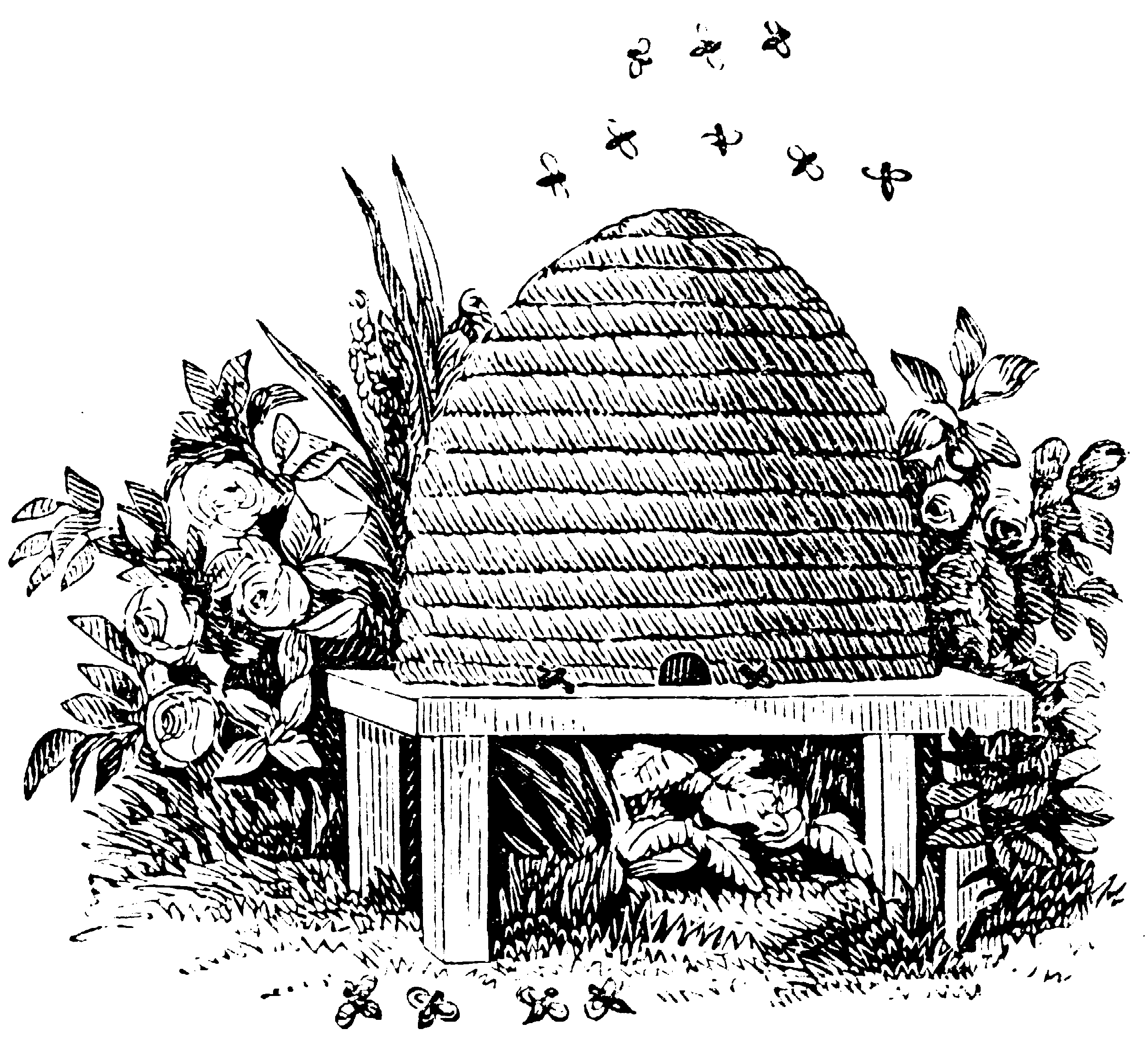
Once upon a time there was a post office in Buckingham County known as Beesville.
In 1880, Robert L. Baber, a Magistrate for the county, lived near there. At one time, he was the owner of Baber’s Mill, on Rock Island Creek, where there was a grist mill as well as a saw mill.
In 1880, his son,Thomas Howard Baber, operated a grocery at Beesville. Robert L. Baber, Jr. was also a retail grocer.
Did a farmer in the Rock Island Creek neighborhood keep bees?
Can a Slate River Ramblings reader comment further about Beesville, particularly how it got its name?
For more about Baber’s Mill:

Sharon Baptist Church, Photo by Joanne Yeck
Thomas Nicholas Johnson was an exceptionally vigorous man. In 1867, at the age of fifty-five, he conducted the marriage ceremony for my then youthful ancestors, John T.L. Woodson and Mary Elizabeth “Betty” Saunders. Betty Saunders’ parents were members of Sharon Baptist Church.
More from Virginia Baptist Ministers:
His ministry covered a period of sixty-three years. The country pastorate has its compensations and, along with the exposure of long cross-country rides, comes also physical vigor. Brother Johnson had a magnificent physique, standing six feet two inches tall. Upon one occasion a wicked fellow threatened this man of God with personal violence if he preached at a certain time and place; but he did preach at that place and time, nor was he molested.
As a preacher he was patient and careful in his preparation; clear, logical, simple in his presentation of the truth. He was felicitous in his use of illustrations and effective in his quotations from the Bible. While by nature timid and shrinking, this weakness was not a hindrance to him in the pulpit. . . .
He was married three times. Of the first marriage only two children lived to maturity. The daughter became the wife of Rev. Dr. J. A. Mundy. Of the two children of the second marriage, one became the wife of Rev. Dr. W. J. Shipman. The eight children of the third marriage all lived to the estate of manhood and woman hood. His home was a happy one. For many years he lived on his own farm, in a comfortable dwelling, not far from his Mulberry Grove Church.
He once expressed the desire that he might die at home in his own bed. This desire was granted to him. After two months upon a bed of sickness, during which time he displayed not only patience, but even ecstatic joy, he was called to his heavenly reward on September 13, 1894.
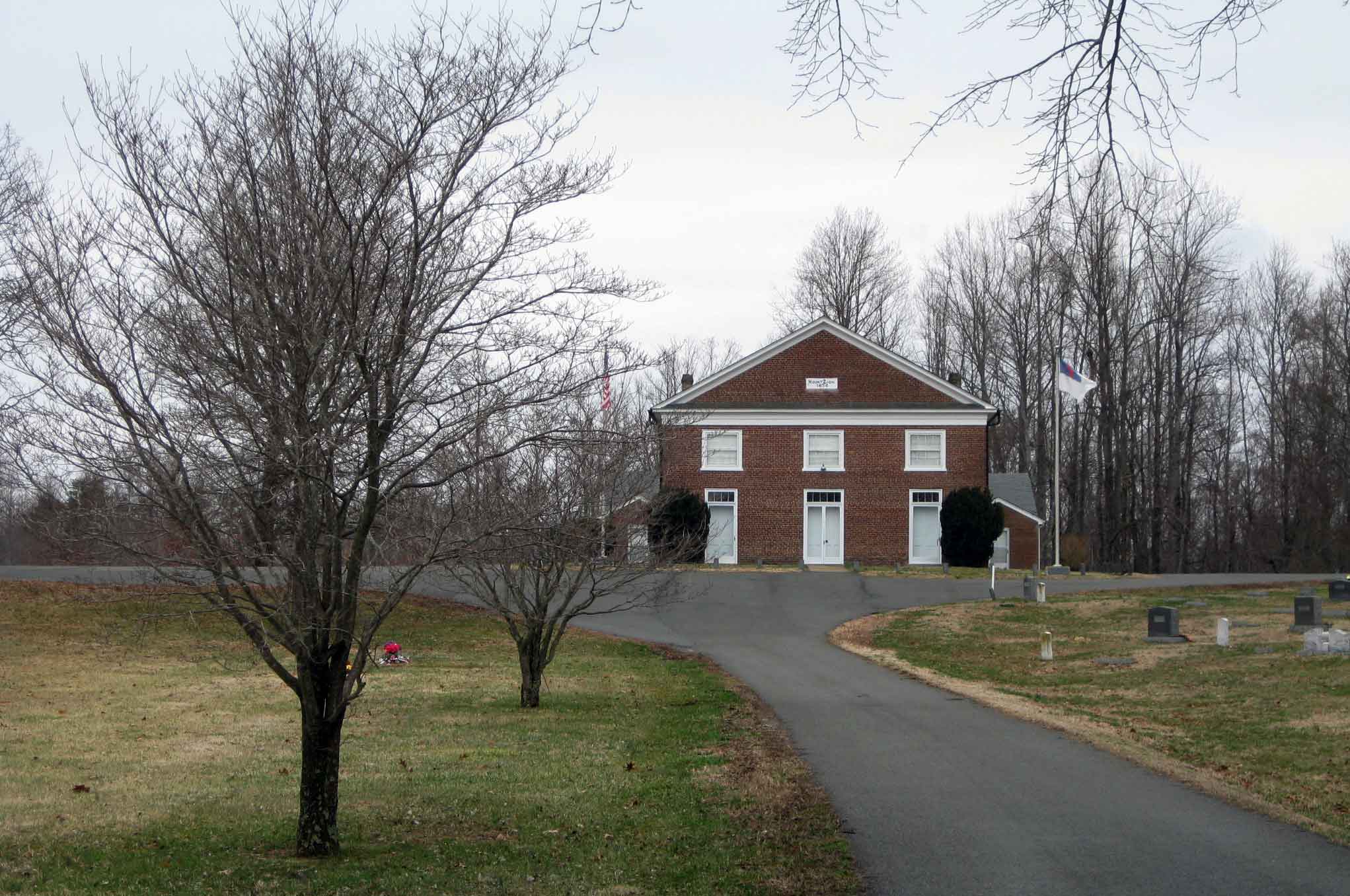
Mount Zion Baptist Church, Photo by Joanne Yeck
Rev. Thomas Nicholas Johnson was one of Buckingham County’s best educated and longest-lived minsters. First studying with Elijah G. Hanes at Humanity Hall Academy when it was at Physic Springs, he went on to Virginia Baptist Seminary (later Richmond College). In addition to his ministry, he may have founded a school in Buckingham. Click here to learn more:
Buckingham Schools: Rev. Thomas N. Johnson
In Virginia Baptist Ministers, his biography begins:
This sketch is based on an article by Rev. Dr. L. R. Thornhill in the Religious Herald upon the life of Rev. Thomas Nicholas Johnson. He was born June 20, 1812, in Buckingham County, Virginia, near Mount Zion Baptist Church. Although his parents were not Christians, he early made a profession of his faith in Jesus. His father died when he was eight years old, leaving a widow and two sons. He was convicted of his sins at a meeting when the venerable minister, walking down the aisle and speaking to persons about their souls, said to him: “Young, Tommie, but not too young to die.” The boy had prepared an answer for the preacher, but he had been approached at an unguarded point; the arm of conviction had reached him. When sixteen years of age he took a decided stand for Jesus, and three years later determined to become a minister.
In July, 1836, he was ordained, the presbytery consisting of Elders P. P. Smith, William Moore, and Joseph Jenkins. After laboring as a missionary of the General Association of Virginia, in 1837 he accepted a call to Sharon, Mulberry Grove, and Enon Churches, in Buckingham County, Virginia. He remained as pastor at Sharon seventeen years; at Mulberry Grove, with two short breaks, for fifty-seven years; at Enon first only a short time, but later was there for eleven years, and still later for twenty-one years. His other pastorates were at Fairmount and Mount Shiloh, in Nelson County, and Hebron and Liberty Chapel, in Appomattox County.
For more about Rev. P. P. Smith, click here: Buckingham Notables: Rev. Poindexter Patteson Smith
To be continued . . .

Buckingham Lodge No. 242 was originally chartered as Andersonville Lodge No. 242 at Andersonville, Buckingham County, Virginia. The request for a dispensation from the Grand Master of Masons in Virginia was made on April 26, 1891. The first stated communication was held at Andersonville on July 6, 1891, with twelve of the thirteen members present. Those attending were: J. B. Gilliam, Emmett D. Gregory, A. C. Garnett, Jr., R. M. Anderson, W. E. McCraw, J. W. Word, P. A. Grigg, E. Van Anderson, J. Lee Coleman, J. H. Harris, John J. Spencer and Samuel Wheeler. R. H. Spencer was the charter member not present. The initial officers were: J. P. Gilliam (Worshipful Master), E. D. Gregory (Senior Warden), A. C. Garnett, Jr. (Junior Warden).
On February 9, 1892, the District Deputy Grand Master, Right Worshipful H. G. Harris, and members of Stonewall Lodge No. 200 and Taylor Lodge No. 117 consecrated the Lodge at Andersonville.
Yearly dues were $2.00 and members enjoyed two meetings each month.
During the 1890s . . . The celebration of Saint John’s Day, an annual social affair at the lodge, included a traditional oyster stew. A charity collection took place at each meeting. The Stewards and Tilers of the Lodge were responsible for the refreshments for members and visitors, as well as tending to members’ horses.
In 1907, the Lodge moved to Buckingham Court House and, on February 26, 1907, the name was changed to Buckingham Lodge No. 242.
To learn more about the lodge, click here: Andersonville Lodge No. 242

The long awaited reprint of Eugene A. Maloney’s A History of Buckingham County is now available. Originally published in conjunction with the US Bicentennial in 1976, the book has been out of print for many years.
The price is $20.00. Copies are for sale at Buckingham’s Historic Village, Housewright House Museum, and Nancy’s Gift Shop in Buckingham Court House.
Copies will also be available at the Spring Membership Meeting of Historic Buckingham which will be held on April 27, 2014.
Location: Brown’s Chapel, Gravel Hill Road.
Time: 2:30 PM.
To purchase the book by mail, send $25.00 to:
Historic Buckingham, Inc., P.O. Box 152, Buckingham, VA 23921

Ruins of Virginia Mills, photo by Joanne Yeck
From The Gazetteer of Virginia (c. 1834)
New Canton is four miles east of Virginia Mills, by which large quantities of flour are manufactured, they are situated on Slate River, on which several valuable slate quarries are opened. An Iron foundry has lately been opened at New Canton, by which is manufactures all qualities of iron.
Virginia Mills was owned and operated by the Nicholas family. In addition to the mills, there was a post office and a general store. Surviving accounts from the store include the familiar surnames of families whose farms lay along the banks of James River, Slate River, and Hunts Creek — Allen, Bagby, Bolling, Brown, Chambers, Guerrant, Harris, etc.
Edward W. Sims was one of the individuals behind the development of the foundry, Buckingham Iron Company. In 1840, the operation employed white men, 3 free blacks, and 32 male slaves between the ages of 24 and 36. The labor was divided between mining (12 men) and manufacturing (38 men). Buckingham Iron Company was a significant, though comparatively short-lived, endeavor. By 1844, the furnace was being offered for sale.

James River at New Canton, photo by Joanne Yeck
My ancestor, Charles S. Saunders worked as a tailor in New Canton, Buckingham County. He married a planter’s daughter, Elizabeth Holman Chambers, and, eventually, took over a large portion of her father’s farm at Chambers’ Mills.
Here is a brief description of New Canton, as Charles Saunders knew it when he set up shop:
From The Gazetteer of Virginia (c. 1834)
New Canton, Post Village, in the northern part of the county, 63 miles west of Richmond and 138 from Washington, D.C., situated at the mouth of Slate Creek, on an elevated bank about a fourth of a mile from James River, commanding a beautiful perspective view down the river. It was once a place of considerable trade, but has been for sometime rapidly declining. It contains thirty-six dwelling houses, three mercantile stores, one tavern, one flour manufacturing mill, one tan yard, and one saddler. A Free House of worship is situated a mile from New Canton. . . .
New Canton has one attorney and one physician. Population 50.
By 1843, the town will also boast a tailor, Charles S. Saunders.
To be continued….
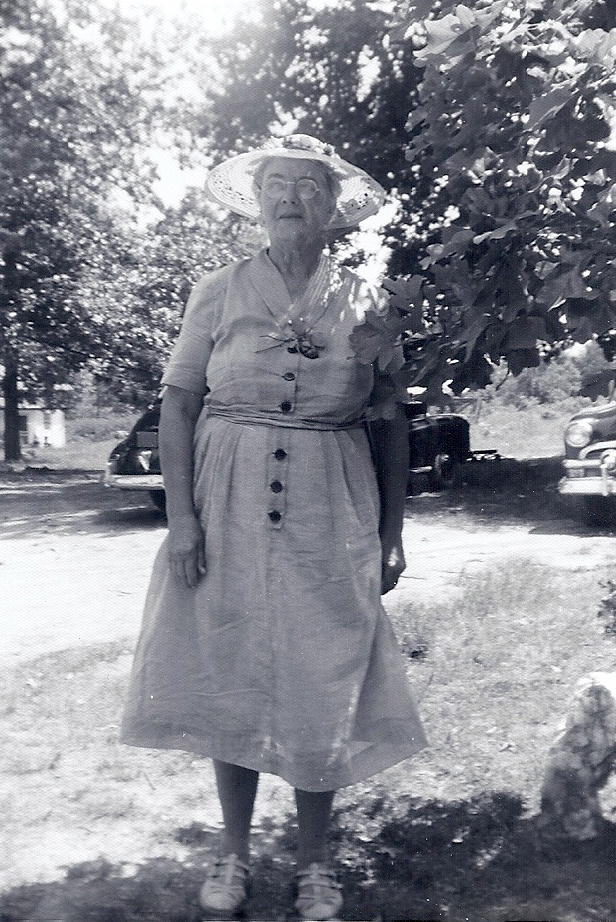
Courtesy Gordon G. Ragland, Jr., Maxey/Patteson Family Collection
Mary Louise “Lulie” Patteson is best remembered for her dedication to preserving the history of Buckingham County. Her long memory of people and places helped inform the Virginia Historical Inventory surveys recorded in the 1930s by Garnett Williams and Elizabeth McCraw. Her contributions to regional newspapers, particularly Charlottesville’s The Daily Progress and The Farmville Herald, were enjoyed and clipped by many devoted readers.
Miss Lulie was also a school teacher. In about 1897, after completing her education at Well Water School, she took the state board examinations for teachers. Her high scores earned her a “first grade” certification; however, this classification was reserved for teachers over twenty years of age, with a minimum of ten consecutive school months’ experience. Lulie was initially given a “second grade” certification instead, intended for competent, but inexperienced, teachers. With her “second grade” certification, Lulie could teach only in Buckingham County and work was scarce.
“On my 18th birthday,” she remembered, “I applied for a teaching position and was finally given a two months job at a school they were planning to close. My pay was $40 for the two months. I gave mother $35 and kept $5 for myself. It was difficult to obtain any teaching positions, I did not teach again until I was 21. At that time, I became assistant principal and teacher at Well Water School.”
For more about the life of Lulie Patteson, consult “Miss Lulie Patteson: Early Buckingham Historian,” in “At a Place Called Buckingham.”

Courtesy Jeremy Winfrey and Virginia Historical Society
Buckingham history is scattered everywhere!
An account between William Hill Winfrey and George Hocker of Hocker’s mill has survived and is contained in the Allen Papers, housed at the Virginia Historical Society.
Dated 1840-1843, it shows that “Winfree” purchased bran, flour, wool, and wood at Hocker’s Mill. Hocker also backed Winfree’s note to John Jenkins, due June 13, 1842, for $15.91.


 slate river ramblings . . . .