

Slate River Mills, rebuilt after 1905
Courtesy of Historic Buckingham
Hocker’s Mill, also known as Slate River Mills, was the subject of a very brief Virginia Historical Survey written by Garnett Williams. She located the mills at 1.9 miles south of Dillwyn; however, sometimes Mrs. Williams confused her directions. The mills are actually north of Dillwyn.
The original mill, owned over the years by the Hocker, Dowdy, Anderson, and LeSueur families, burned in 1905. One of the first water-turned mills in Buckingham County, Garnett wrote that it had been a very large, well-constructed building. The mill that replaced it burned in the 1940s.
In 1860, George Hocker reported proceeds for his grist mill, where he processed 15,000 bushels of wheat (worth $18,000) and 10,000 bushels of corn (worth $10,000). He employed three men at the mill. In 1870, Hocker reported earnings from both a grist mill and a saw mill. He worked at the saw mill and had four additional men in his employment.
Correction: According to an article found in the Appomattox and Buckingham Times, the mill burned in 1908.

Maysville Presbyterian Church, Courtesy Historic Buckingham
In 1856, when William H. Wilson advertised his intended sale of Oakley, he emphasized the farm’s proximity to Maysville and Buckingham Courthouse. This made the plantation an excellent choice for a professional working in the village or for a farmer desiring a ready market for his produce.
. . . The propinquity of the flourishing and delightful village of Maysville, affords a regular and sure market for milk, butter, poultry, and indeed, everything that can be furnished from the garden, dairy or stock, as well as a regular demand for from fifty to one hundred cords of fire wood.
The facilities of getting the crops to market are very great. Slate River is only one mile from the Farmville Plank Road, approaches within six miles of the place, and Hocker’s large manufacturing mills are only six miles distant, and the estate is most convenient to church, mill, and to the blacksmith’s shop.
One of the convenient churches was Maysville Presbyterian.
Coming Next: Hocker’s Mill

American Farm Scenes No. 3 (1853), by Fanny Palmer
In 1856, something was stirring in Buckingham County.
A significant number of valuable Buckingham farms and other businesses were advertised for sale in the Richmond newspapers. Did sellers attempt to take advantage of a strong market? Did they anticipate a dip? Was the climate in Buckingham shifting towards increasing industry, making those properties more valuable? Did the political battles over the Kansas Territory concern Buckingham County slaveholders? Was it just coincidental?
Among these advertisements was this one for Oakley placed by the owner, William H. Wilson:
VALUABLE BUCKINGHAM LAND FOR SALE
If not previously sold I will offer for sale at public auction, on the premises, on TUESDAY, the 2nd day of September next, my tract of land called OAKLEY, lying within one mile of Buckingham Court House, and containing about 600 acres.
It is seldom that so pleasant and desirable a residence, either for a private or professional gentleman, is offered for sale. It lies in one of the most healthy, wealthy and intelligent neighborhoods in the State. The situation is very elevated and beautiful, commanding an extensive view of the range of Blue Ridge Mountains, and of many of the fine plantations on Slate River. The improvements are sufficient for the accommodation of a large family, white and black, and in good repair, with an excellent ice house, all necessary outhouses, and an abundance of excellent spring water….
There is also a good mill seat on the estate, at which a mill once stood.
Coming Next: Maysville in 1856

In 1832, Daniel Guerrant advertised his tavern near Buckingham Courthouse for rent or lease. He is likely the same man who married the widow Elizabeth (Putney) Moseley. His offer read as follows:
FOR RENT OR LEASE – My Tavern in Maysville, at Buckingham Court-house; the buildings are spacious and well calculated for a public house. There is attached to the Tavern a convenient family house, and the other necessary out buildings, a well of excellent water and an extensive garden; the stables contains upwards of fifty stalls, situated at a convenient distance from the Tavern, on a lot of one and a half acres of ground. I would rent or lease the property for one or more years, as may best suit a tenant, and give possession on the first day of January next.
DANIEL GUERRANT
Maysville, August 31.
Is this the same tavern operated by a man named Daniel Guerrant in 1805 and 1811? Guerrant also held ordinary licenses in 1829, 1830, and 1831. Was one of his establishments called the Raleigh?
From more about Guerrant’s tavern(s), see Thomas Jefferson Slept Here

The Peter Guerrant House, Courtesy Virginia Department of Historic Resources
In 2000, the Peter Guerrant House, located not far from the James River in northeastern Buckingham County, was nominated for the National Register of Historic Places. While only a small fraction of the many building that once comprised the Guerrant farm remain, the original dwelling house exemplifies a type of structure once very common in the Buckingham landscape. Most 19th-century houses were not grand or, at least, did not start out that way. Frequently an original dwelling was elaborated with additions, making the Peter Guerrant House all the more interesting because the basic structure survived. From the nomination form:
The Guerrant House built circa 1835 in Buckingham County, Virginia, is locally significant in the category of architecture, as a rare survival of a once prevalent house type – the basic one-and-a-half story frame farmhouse with a kitchen building connected to the rear. Many farmers in the Virginia Piedmont built such structures during the 18th and 19th centuries. Few of these farmhouses survive in toto. Some were incorporated into larger house. Many became slave dwellings, barns or storage sheds as their owners moved to larger or new houses. Most have been lost to fire or abandonment. Much of the Virginia landscape was once dotted with these buildings. Few remain and fewer still in Buckingham County, a county with a relatively low number of buildings built more than 150 years ago. Though weather-beaten and left empty for almost a half century, the Guerrant House retains a high degree of integrity and is a rare and important example of a once common house type.
Coming Next: Daniel Guerrant’s Tavern
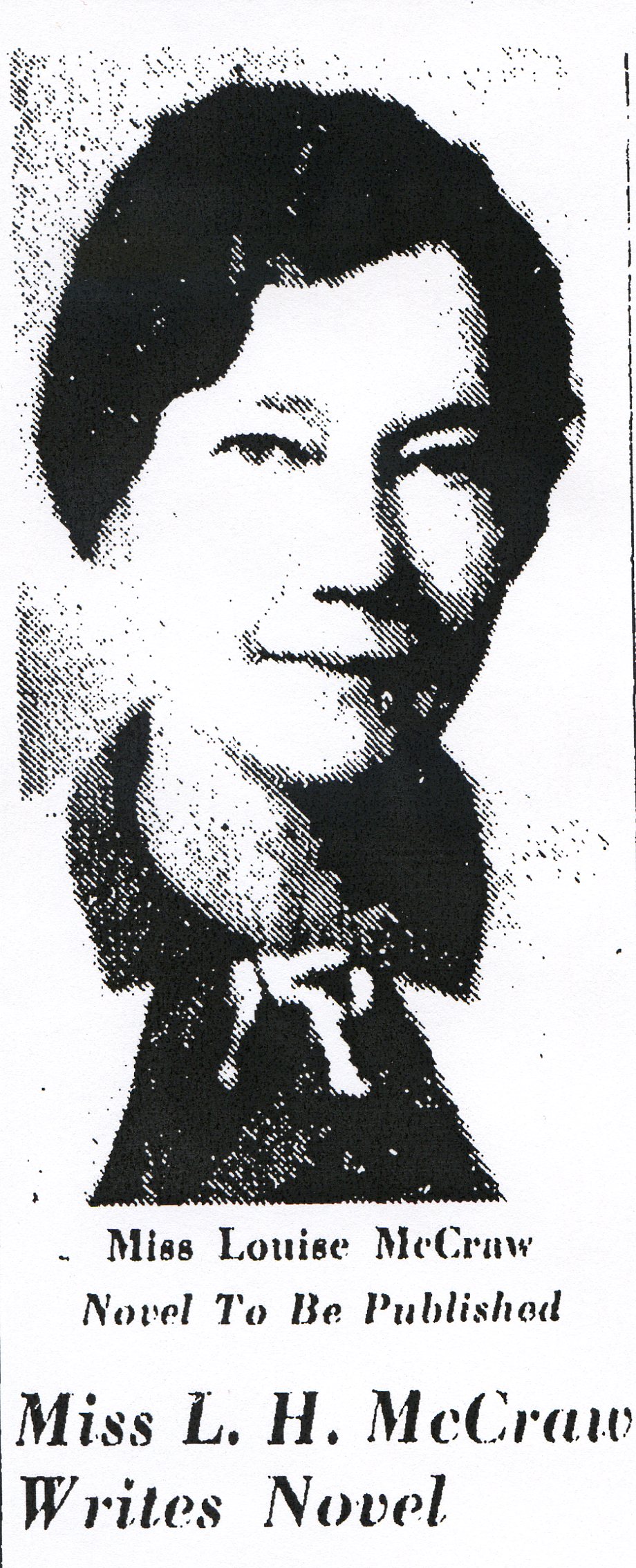 One of Buckingham County’s shining lights was Louise Harrison McCraw.
Don’t miss my profile of Louise in the February 2014 issue of the Buckingham Beacon. It begins:
The daughter of William Emmett and Bettie (Gilliam) McCraw, Louise Harrison McCraw was born in Buckingham County in February of 1893 at her family’s home, The Pines, near Andersonville, in the southern part of the county. By the age of five, she was determined to become a writer. When one of her story-telling, older sisters angered little Louise, she went to the vegetable garden, stamped her foot, and announced, “When I get grown, I’m going to write a book about how bad it is for older children to boss younger children.”
Louise followed through, dedicating her life to writing and to serving the blind through her work at the Braille Circulating Library.
For the rest of the story, download a PDF of the February 28th issue and turn to page 11: Louise Harrison McCraw

It’s late winter of 1835. Got some extra cash? You can invest in the very lucrative Booker’s Gold Mine.
On the second Monday in March, Commissioners met at the store house of Leitch and Shaw, in Maysville (Buckingham Court House), ready to sell shares of stock in Booker’s Gold Mine.
Rolfe Eldridge, Buckingham County Clerk, was one of the six Commissioners supervising the sale.
See below for details.

The deadly Spanish Flu of 1918-1919 was felt in Buckingham County as it was across the nation.
On January 5, 1919, the Richmond Times-Dispatch published that Dr. Garland “Lightfoot” Morris was the only physician practicing at Buckingham Court House.
“[H]e has been terribly overworked and had had the influenza himself. In some homes there are not enough well ones to care for and nurse the sick.”
Did your parents or grandparents talk about the Spanish Flu? If you have a story to share, please comment.


Dr. George W. Bagby
In 1879, Buckingham-born Dr. George W. Bagby published a short memoir entitled, Canal Reminiscences: Recollections of Travel in the Old Days On The James River & Kanawha Canal. He recalled the time, in 1835, when the days of the batteau, poled by African-American slaves, came to an end, giving way to the mighty James River & Kanawha Canal.
~
Fleets of these batteaux used to be moored on the river bank near where the depot of the Virginia and Tennessee Railroad now stands; and many years after the “Jeems and Kanawha” was finished, one of them used to haunt the mouth of Blackwater creek above the toll-bridge, a relic of departed glory. For if ever man gloried in his calling, – the negro batteau-man was that man. His was a hardy calling, demanding skill, courage and strength in a high degree. I can see him now striding the plank that ran along the gunwale to afford him footing, his long iron-shod pole trailing in the water behind him.
. . . They lived well. Their cook’s galley was a little dirt thrown between the ribs of the boat at the stern, with an awning on occasion to keep off the rain, and what they didn’t eat wasn’t worth eating. Fish of the very best, both salt and fresh, chickens, eggs, mill: and the invincible, never-satisfying ash-cake and fried bacon. I see the frying-pan, I smell the meat, the fish, the Rio coffee! – I want the batteau back again, aye!
George W. Bagby
For more about Dr. Bagby, see: Buckingham Notables: Dr. George W. Bagby
In 1858, the Richmond papers printed the “Summer Schedule” for canal boat trips from Richmond to Lynchburg. The entire trip cost $3.50.
At New Canton passengers could connect with the Stage for Buckingham Female Collegiate Institute and Buckingham Court House. At Scottsville, Albemarle County, they could pick up the Stage for Charlottesville.
One could leave Richmond at 5:00 PM and arrive at New Canton at 9:00 AM the next morning, having travelled 66 miles on the James River and stopping at Manakintown, Judes Ferry, Michaux’s Ferry, Ceder Point, Jefferson, Pemberton, and Columbia.
Astonishingly, the ride from New Canton to Scottsville, a mere 13 miles took 3 1/2 hours!


 slate river ramblings . . . .