

Before I discovered Buckingham County, for years, I wrote about Classic Hollywood.
In the 2013 issue of the Magazine of Albemarle County History, I had the extraordinary opportunity to combine my love of the movies with a story about central Virginia in the article, “Hollywood Comes to Howardsville: The Making of Virginia (1941).” It begins:
In 1940, Hollywood motion pictures shot on location were relatively rare. Most movies were made on studio sound stages, on studio back lots, or filmed outdoors at studio-owned ranches in the greater Los Angeles area. The majority of releases during that period were also shot in black and white. Technicolor films were comparatively expensive, the three-strip Technicolor cameras were unwieldy, and film processing was proprietarily controlled by the Technicolor company. At that time, to combine an on-location shoot with color film was even rarer. Thus, in 1940, when Paramount Pictures decided to shoot Virginia on location, transporting cast, crew, and Technicolor cameras to faraway, rural Albemarle County, Virginia, it broke significant new ground.

Hollywood’s invasion of the rather sleepy James River town of Howardsville was not without challenge and mishap. The lovely Madeline Carroll captured many a heart in Albemarle County and Fred MacMurray proved to be just a regular guy who liked to go fishing.
Errors happen and “Hollywood Comes to Howardsville” is no exception. For many details in the article, I relied on the work of Alan Bruns, one-time reporter for The Daily Progress. Spell check can be a blessing and a curse. In the article, regrettably, the letters in his name were transposed to “Burns.”
For more about Alan Bruns, please see Ruth Klippstein’s article, “A Different View,” in the June 2011 issue of Scottsville Monthly.
If you are not currently a member of the Albemarle Charlottesville Historical Society, you can purchase the 2013 issue online: Magazine of Albemarle County History
Slate River Ramblings now has its own domain name: slateriverramblings.com.
Share it with all your friends who love the history of central Virginia!
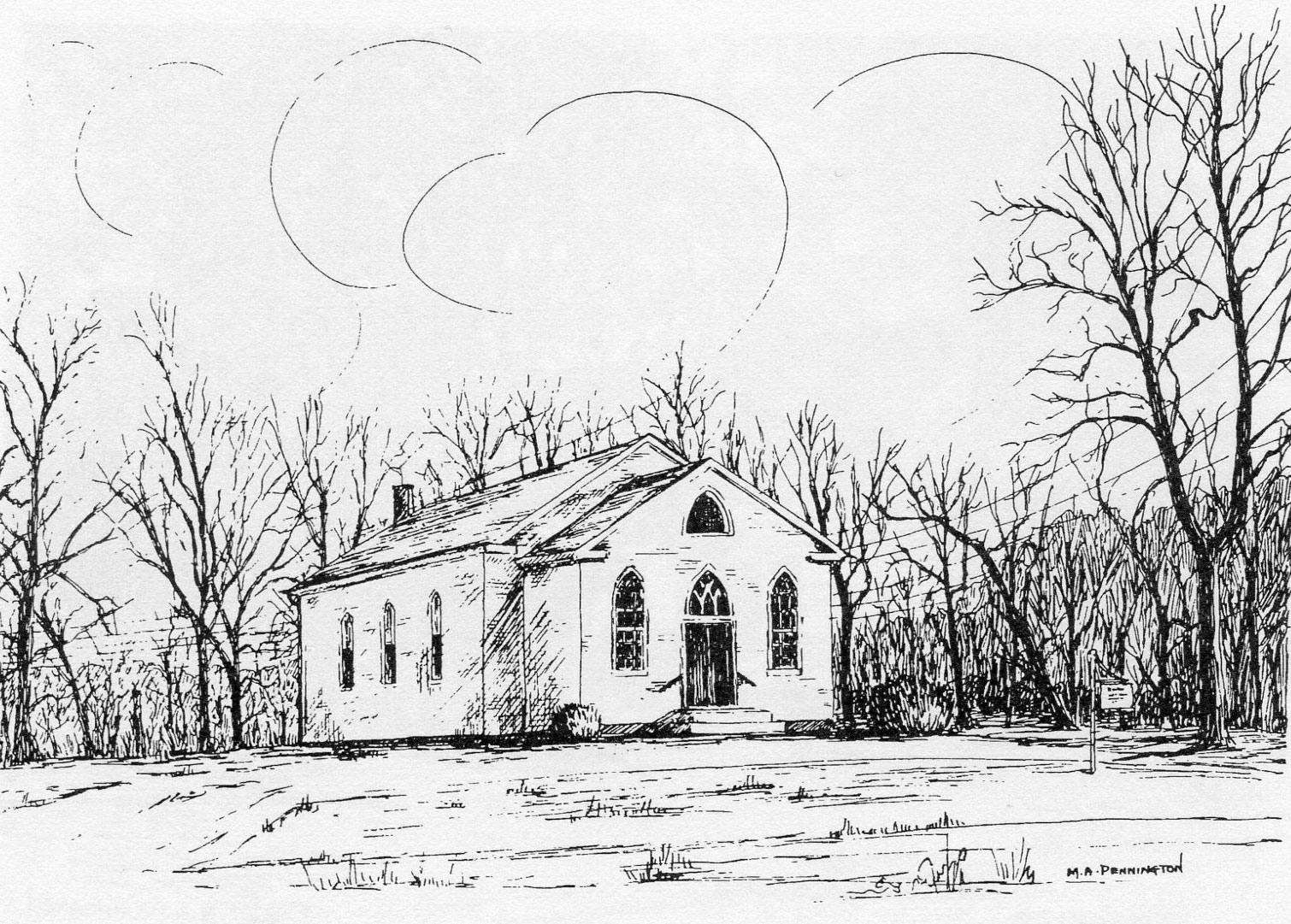
Enon Baptist Church, Courtesy Historic Buckingham
One of the nineteen churches included in Thomas Baldwin’s Gazetteer of the United States (1854), Enon Baptist Church was founded in 1832. According to The Courthouse Burned… Book I:
Enon was first established as Mt. Tabor in 1832. At first it was a log building. In 1838 a new building was built and the name was changed to Enon. In 1854 changes were made to enlarge the church and in 1872 a Bapistry using rain water channeled from the roof was constructed. Essentially the building remained the same until 1940 when it burned to ashes….
Land for the original church is believed to have been donated by Pemberton Dunnevant. Land for the Cemetery was given by Peter Alexander Forbes. Dancy McCraw is reputed to have been the builder of the church that burned.
To catch up on previous posts featuring Buckingham County churches included in the 1854 Gazetteer, just type Gazetteer in the search box at Slate River Ramblings. Enjoy the results!
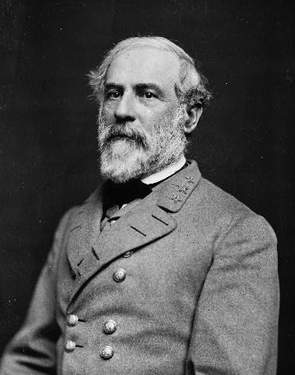
Gen. Robert E. Lee
In 1937, Elizabeth McCraw transcribed a Civil War-era letter for the Virginia Historical Inventory. It was written from Valley Mountain on August 28, 1861, by Frank O. McCraw to his brother who was still at home in Buckingham County. One of seven sons of Thomas McCraw, Frank survived the war and lived to be an old man. In the letter, he makes it clear that both volunteers and regulars had a difficult time from the earliest days of the war and that families left behind in Buckingham were painfully ignorant of their hardships. It reads in part:
I am unfit for any service and have been for the last three weeks. I never suffered so much in my life with the bowel complaint as I have done in that length of time, but I have enough strength to walk and write. A soldier has not as much attention here as a sick cow would have in Buckingham. Dr. Swoope has been here and he says he had not the least idea how we were treated, and the people who were in Buckingham know nothing of the sufferings of soldiers. I weigh about one hundred and twenty-five pounds. A volunteer has all the hardships to undergo that any other class of soldier does and is thought as little of; the treatment is equally as rough, and it is a standing rule here for the volunteers to relieve the Regulars (the lowest Irish) in all their labor. As for the men being drafted in Buckingham I know that will not take place this year, and if I had the money I would bet ten to one it will not be. If one company were in Buckingham I do not believe five out of Eighty would ever join, but wait for a draft. John D. Saunders leaves here with his brother for Buckingham, he has been very sick for the last five weeks with measles, and the Drs. have given him a discharge, which I think very proper.
We have no fighting and I do not expect we will in several weeks. Genls. Lee and Loving are here….

Thomas Jefferson, Engraving of Gilbert Stuart Portrait
In the early 19th century, Daniel Guerrant operated the Raleigh Tavern, located near Buckingham Court House. Among other notables, Thomas Jefferson enjoyed the table at the Raleigh and may even have slept there.
Going to and from Monticello and his Bedford County home, Poplar Forest, Jefferson typically crossed the James River at Warren Ferry. On several trips, he noted that he stopped at the Raleigh for corn or oats, presumably for his horse. Sometimes, he stayed for breakfast. Jefferson’s bill for dining at the Raleigh varied from $1.00 to $1.96 to a whopping $2.33.
In 1815, Thomas may have stayed the night at the Raleigh when he appeared at Buckingham Courthouse to defend the first will of his brother, Randolph Jefferson. On September 12th, he tipped the Raleigh staff $.25.
According to legend, in 1811, Daniel Guerrant’s tavern and stage stop was elaborated into what became known as Rose Cottage. Located on Route 690, the original building was expanded by Robert Shaw and, later, owned by William P. Shepherd.
Daniel Guerrant paid for an ordinary license in 1805 and not again until 1811. In the gap between 1805 and 1811, did Guerrant close his old building and open a new Raleigh Tavern in 1811, selling the old structure to Robert Shaw?
If any Slate River Ramblings readers know more about Daniel Guerrant and his tavern(s), please comment.
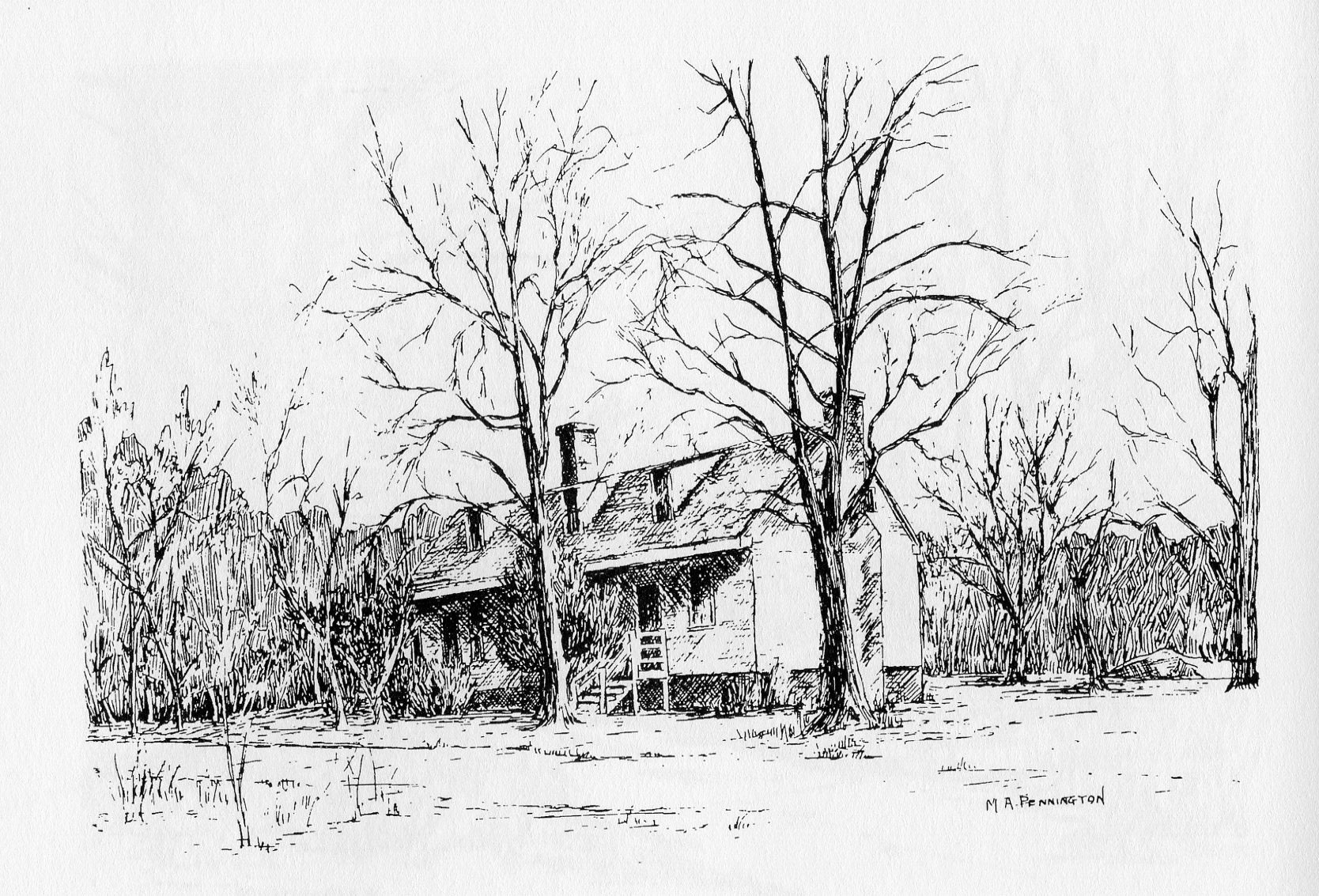
Rose Cottage, Courtesy Historic Buckingham
William P. Sheppard was the one-time owner of Rose Cottage, located just south of Highway 60, on Route 690 near Buckingham Courthouse. Originally a stagecoach inn, Garnett Williams, in her Virginia Historical Survey, waxed eloquently over Rose Cottage: “This is one of the most historical places in the county, for it was on this farm that General Robert E. Lee camped with his men on his return to Richmond.” That night, so the story goes, Lee declined a bed in Mr. Sheppard’s cottage. “This will be my last night in camp with my men,” Lee said, “and I prefer to spend it with them, but I have several sick men I would like for you to care for.” And this, wrote Mrs. Williams, “Mr. Sheppard did gladly.”
From more about General Lee’s retreat through Buckingham County, see:
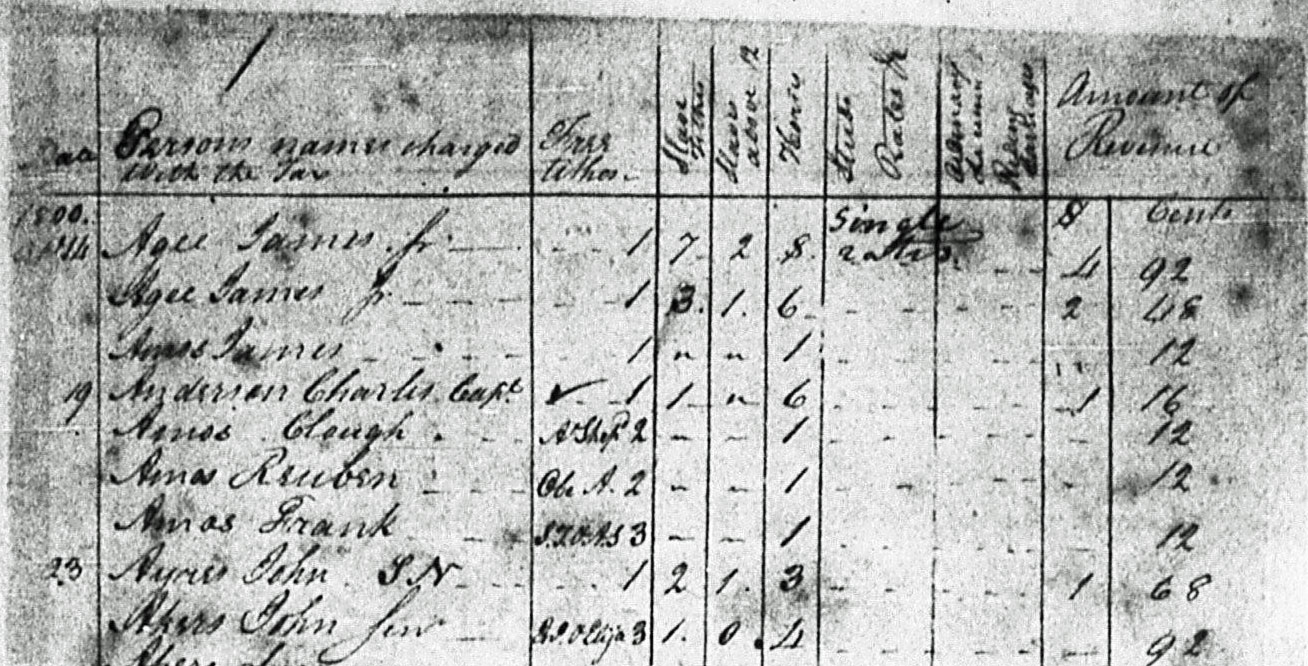
Buckingham County Personal Property Tax, 1800
John “Jack” Ayres was born in Buckingham County on January 22, 1772. According to Harry S. Holman, Rev. Ayres was a Methodist licentiate, not an ordained minister, and preached at Stoney Batter, which was located between Humanity Hall and his home at Edge Hill on the Slate River. During his very long life, he served Buckingham well.
He officiated at many weddings, including that of his granddaughter, Elizabeth H. Ayres, daughter of Col. John B. Ayres, who married, Robert H. Ayres, of Highland County, Ohio. The marriage took place on May 19, 1836, at Crab Orchard in Buckingham County.
Pastor Ayres also ministered to the dying and was at the death bed of Susan Chambers, whom he had known all her life. His daughter, Elizabeth “Betsy´´ Ayres, was the first wife of Susan’s uncle, Edward “Ned´´ Chambers.
Susan’s obituary reads in part:
… sending for the Rev. John Ayres- to which the Doctor assented, remarking, that never having committed sin she, consequently, had nothing for repentance. The parson had the interview, and after a few interrogatories, found that she had been mindful of the one thing needful, and prepared to meet her God, no doubt from the time she possessed the moral faculty.
Susan, who was educated at the best female schools and at the Buckingham Female Collegiate Institute, died on November 10, 1839, age eighteen.
I’m delighted to announce that the October 2013 issue of The Virginia Genealogical Society Newsletter features “Finding Randolph Jefferson.” It in, I discuss, at length, many of the methods and sources I used to uncover the story of Thomas Jefferson’s only brother.
The article begins . . .
I first became aware of Randolph Jefferson while searching for my Harris family in nineteenth century Buckingham County. After surviving the Civil War, Buckingham’s courthouse burned in early 1869. Prior to that catastrophe are the loss of many of Albemarle County’s records for the period 1744–1761, when the land that became Buckingham was part of a much vaster Albemarle, wiping out Buckingham’s pre-history, as it were. Under such circumstances, it is easy to throw in the towel before even beginning. Anyone researching burned counties must be creative, dogged, and patient. Genealogical rewards can be very slow to materialize; but remarkably they often do (and in the darnest places), making it all the sweeter.
Conducting research in burned counties, like Buckingham and Appomattox, can be very tough work. We can all learn from the discoveries of others and the Virginia Genealogical Society is a marvelous source for both facts and techniques to help locate even the hardest to find Virginia ancestors. Since 1973, The Virginia Genealogical Society Newsletter has been printed monthly and, in 1982, the Society began to publish feature articles.
Current members receive the Newsletter. Back issues are available online for purchase and are collected at many libraries and historical societies including: Library of Virginia, Virginia Historical Society, and Jones Memorial Library (Lynchburg, Virginia).
If you aren’t already a member, please consider joining. Click here to explore the benefits: Virginia Genealogical Society.

Sprouse’s Court Vintage Postcard, Sprouse’s Corner, Buckingham County
Motor courts and specially motels were once delightfully original, welcoming travel weary Americans as they saw the U.S.A. in their Chevrolets. In Buckingham County, Sprouse’s Court dominated the crossroads at intersection of Highways 15 and 60.
The current exhibit at the Library of Virginia, “No Vacancy: Remnants of Virginia’s Roadside Culture,” focuses on motels and tourist courts along Virginia’s historic Route 1. For those of us who are unable to visit the Richmond exhibit, the Library has posted a charming sample of Vintage Motel Postcards.
For more about the exhibit click here:
No Vacancy: Remnants of Virginia’s Roadside Culture, October 15, 2013–February 22, 2014

Here’s the next in a series of detailed maps of Buckingham County, focusing on the part of the county that lies between the James River and Highway 20.
For thirty years, my Norborne Harris family lived in this section of the county at Chestnut Grove, near Centenary Methodist Church. The farm was originally called the “Bondurant Tract.” Their neighbors included many familiar Buckingham County surnames: Layne, Catlett, Moseley, Steger, Tapscott, Tindall, and Robertson.
Key for the “Points of Interest” in green:
18. Hatton’s Ferry
36. Yogaville
Also Note:
Rock Island Creek mentioned in the recent post about Buckingham Mills: Baber Mill.
Click here for more about Centenary Methodist Church, located on Highway 20, just south of Route 678.
Click here for more about Hatton Ferry.


 slate river ramblings . . . .