
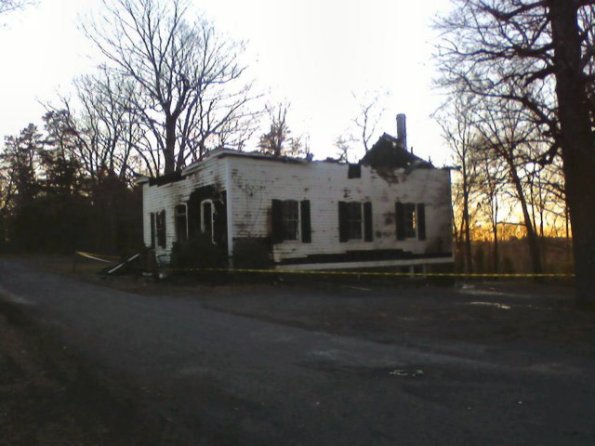
Courtesy Arvon Presbyterian Church
Many Slate River Rambling readers may recall that, on January 15, 2009, the Sanctuary of Arvon Presbyterian Church was destroyed by fire. The attached annex was spared major damage. Built in 1885, the church was a Buckingham County treasure.
Fortunately, it has been rebuilt as closely as possible to the original design. On Palm Sunday, April 1, 2012, services were resumed at the church, once again scheduled for the first and third Sundays of each month.
Arvon Presbyterian Church has a wonderful website, which also features histories for Fork Union and Trinity churches. Click here for Arvon Presbyterian Church.
A stunning gallery picturing the fire is also available at the website: Arvon Fire.
Many thanks to Pastor Joe Allmond for getting in touch with Slate River Ramblings and sharing these details.
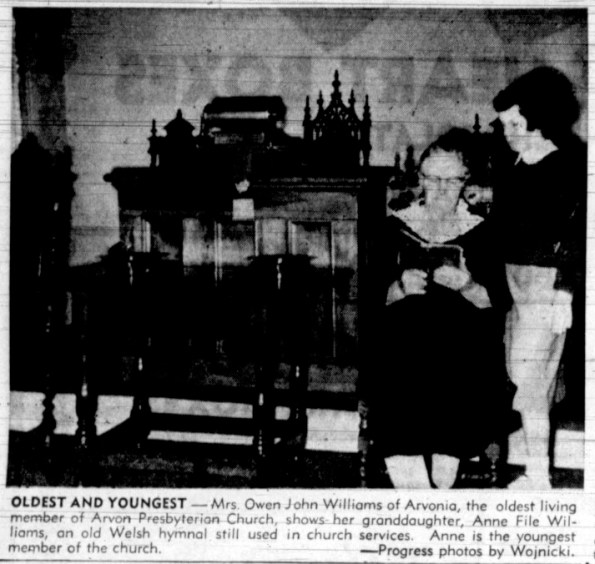
Courtesy the Daily Progress. Photo by Mrs. R. J. Wojnicki.
In 1959, Mrs. R. J. Wojnicki reported that Mrs. Owen John Williams was the oldest member of Arvon Presbyterian Church. Mrs. Wojnicki’s lengthy article, “Welch Quarrymen Organized Church In Buckingham” (The Daily Progress), concluded with details about Mrs. Williams life. At that time, she had been a member for almost fifty-two years, joining the church when Rev. Plummer F. Jones was pastor. For over forty years, Mrs. Williams taught junior classes in the Sunday School, only taking a break when her sons were born.
Mrs. Williams remembered when the adult Sunday School classes were taught in Welsh. In 1959, Welsh hymnals were still kept in the church.
Born Sarah Louisa File, on December 26, 1872, at Ransons, Buckingham County, Mrs. Williams was a first generation American on her father’s side. Her father came to Virginia from England and her husband, Owen John Williams, emigrated from Wales in 1891. Mr. Williams first worked in Vermont as a slate maker, later moving to Arvonia. The couple was married in 1907 and, from 1928 to 1934, Mr. Williams served as Treasurer of the church. When he died in 1934, Mrs. Williams took over as Treasurer, serving until 1958.
Mrs. Wojnicki also noted that while Mrs. Williams was the oldest member of Arvon Presbyterian Church, her ten-year-old granddaughter, Anne File Williams, was the youngest.
For much more about Arvonia and its slate quarries, search the archives at Slate River Ramblings and enjoy the results.
Special thanks to Phil James for sharing the article from Charlottesville’s Daily Progress.
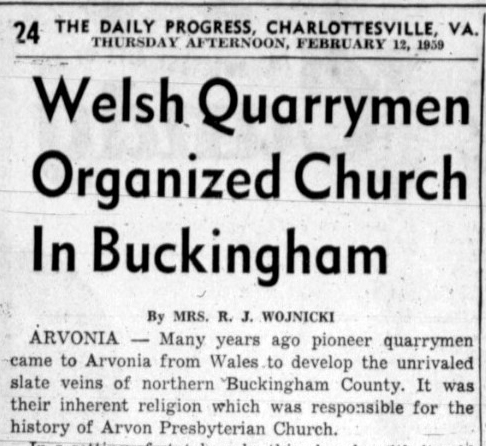
Courtesy The Daily Progress.
In 1959, Mrs. R. J. Wojnicki described the early years of Arvon Presbyterian Church in her article for Charlottesville’s Daily Progress, “Welch quarrymen organized church in Buckingham”:
Arvon Presbyterian Church was constructed on land donated by the Slate Corporation of Edwards and Roberts. Much of the material used in its construction was given by the people of the community.
The Rev. W. H. Wilson became pastor in 1890, a short while before the completion of the new church. The church was dedicated November 23, 1890, by Rev. W. W. Moore, D. D., of the Union Theological Seminary.
A series of pastors followed and, in 1904, Rev. Plummer F. Jones became the regular pastor. Rev. Jones was also an official weather observer. Click here for more Buckingham County: Earthquakes.
Many church records from the early years survive, and as with other churches at that time, members were suspended for infractions such as drunkenness or profanity. Those accused who failed to explain their misconduct were dismissed from the church.
Coming next: Buckingham Notable: Mrs. Owen John Williams

Courtesy the Daily Progress. Photo by Mrs. R. J. Wojnicki.
Published in 1959, Mrs. R. J. Wojnicki’s article for Charlottesville’s Daily Progress, “Welch Quarrymen Organized Church In Buckingham,” highlighted the history of Arvon Presbyterian Church, as well as its many pastors and its membership.
She noted that the village of Arvon was founded in 1867, at the suggestion of John R. Williams, the Slate manufacturer. It was named in honor of Caernarvon, Wales. Before there was a church, meetings were held at the home of Michael E. Jones. Known as “The Old Castle,” the building was razed in 1958. Initially, services were conducted in Welsh to accommodate the immigrant population. As more villagers spoke English, both languages were used. In the early days, Sunday School meetings were held at boarding houses. John W. Edwards erected a “Brush Arbor” at his home, used for summer gatherings.
Mrs. Wojnicki continued: “About 1880 a community house was built on land given to the village by William Pierce. In this building, religious services were held. The Rev. William S. Thompson, pastor of Trinity Presbyterian Church, preached once a month.”*
Later, Rev. M. B. Lambkin took over as pastor of Trinity and headed a committee assisted by elders W. W. Holman and John W. Risson, who were sent to Arvon to organize the new church. This was accomplished on September 26, 1885 and the first elders were W. G. Edwards (Clerk), William Pierce, John McLave, and Thomas R. Jeffrey. Mrs. Wojnicki went on to list the church’s charter members, including many familiar Arvonia surnames such as Pitts, Jones, Morgan, and Pierce.
Click here for more about “The Old Castle.”
*According to Bob Jeffery, the land was given by his ancestor, Elizabeth Saes Pierce, wife of William Pierce.
Coming next: Arvon Presbyterian Church, The Early Years
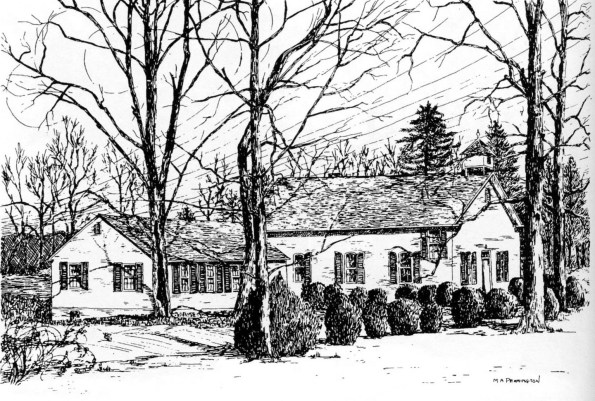
Arvon Presbyterian Church
Sketch by Margaret Pennington. Courtesy Historic Buckingham.
Arvonia, and its inhabitants, is one of the favorite topics at Slate River Ramblings. In 1959, Mrs. R. J. Wojnicki wrote a lengthy article for Charlottesville’s Daily Progress about the founding of Arvon Presbyterian Church entitled, “Welch Quarrymen Organized Church In Buckingham.” She began by describing the church’s setting, its architecture, and appointments.
In a setting of stately oaks this church, with its old world atmosphere, has been tended to with loving care throughout the years and stands as an enduring memorial to the Welsh pioneers.
The double-doored entrance to the church is reached by a terrace of slate. The doors open into an eight-foot vestibule extending the full width of the building which measures about 40 by 50 feet.
At the front, on a two-step dais, is the original pulpit of mellowed pine, together with five 17th-century fruitwood chairs which came from a castle in Austria. These chairs are upholstered in deep blue plush. At the right of the pulpit is the organ and choir chairs arranged at an angle in back of a curved railing. An arched pattern of wood frames the background of the rostrum.
At the rear of the church, running its full width, is a balcony. The balcony, with its original rail, is matched by the chair rail. High walls are of a light, soft green, with carpeting in a deeper shade of green. There are 11 windows in the church and from the ceiling hang two chandeliers.
Coming next: Founding Arvon Presbyterian Church
Click here to read about early weddings at Avon Presbyterian Church: Four Weddings in Arvonia.
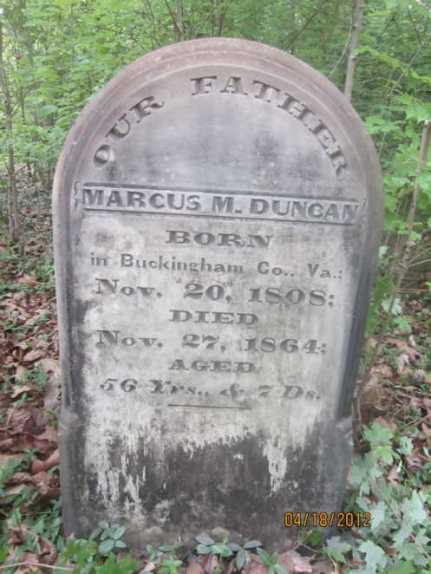
Marcus M. Duncan (1808–1864).
Mardisville Cemetery. Talladaga, Alabama. Courtesy ancestry.com.
In 2017, Slate River Ramblings published posts about the Clay family and their home, Pleasant Grove.
At that time, Slate River Ramblings reader Dave Duncan commented with more information about Junius Clay, who became the guardian for Duncan orphans in Buckingham County.
This handwritten note was found on the back of a letter dated Oct. 1, 1921, Violet Bank Studio, Petersburg, VA.
I wish I could give you the information desired as to George Duncan. This is all I know. My grandfather Marcus Monroe Duncan was the son of George Duncan. He was born in Buckingham Co., VA. He & his brother George & sister Eliza were left orphans at an early age, Mr. Junius Clay being guardian. The Buckingham records were destroyed & our family Bible burned. I think my gr. gr. grandfather was also George Duncan of Albemarle or Fluvanna Co.—his wife Ann & his lands on both sides of the river— Hardware, I think. The family tradition is that he was a Rev. soldier. So he would probably be listed from one of those 3 counties as a soldier.
Thanking you for any trouble,
Sincerely yours,
Alice V. D. Pierrepont.
When Marcus M. Duncan died in 1864, Junius Clay was married and about sixty-years old.
Does a Slate River Rambling reader know what became of the Duncan orphans or more about the life and death of Marcus M. Duncan?
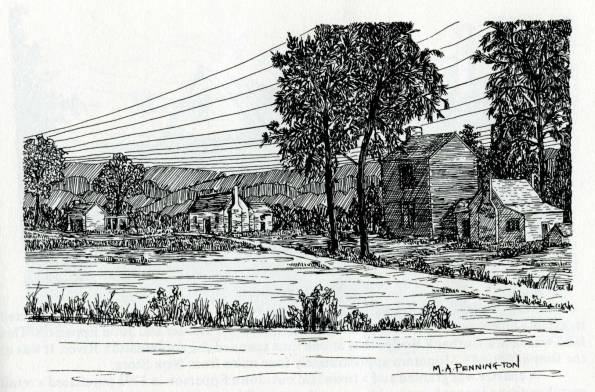
Sketch by Margaret Pennington. Courtesy Historic Buckingham.
John R. Gilliam, who was recommended to serve Buckingham County as a Magistrate during the Reconstruction Era, lived at Osceola in Buckingham County. Spellings for the farm have varied over the years, including “Osie Ola,” which is how it appeared on the survey for the Virginia Historical Inventory.
In 1937, Rosa G Williams wrote this for the Inventory:
This is one of the oldest homes in Buckingham County. It seems the house has been added to several times. The original rooms numbered only three and later it is thought a shed room was added to the southern end of the house and one room added to the east. Many years later two rooms were added to the north. The gable ends face north and south which gives the house a very ancient appearance.
You enter the house through a small square front porch. From there you go through six panel hand made doors. The doors to the original rooms were put together with wooden pegs while the doors of the other rooms were put together with shop made nails and wooden pegs. The downstairs rooms are very large and are plastered with a thirty-six inch wainscoting and about a six-inch chair rail. There is a fire place in each room with the exception of two.
There are no original outbuildings standing at the present time, but you may see piles of rock and fallen chimneys darted about the place where slave cabins once stood. The Gilliam family had many slaves.
Many thanks to Slate River Ramblings reader L. D. Phaup for leading me to more information about the Gilliam family.
Read more at the website: Gilliams of Buckingham County.
For more about John R. Gilliam at Slate River Ramblings, see:
Reconstruction in Buckingham County, Part II
Reconstruction in Buckingham County, Part VI

When Elizabeth McCraw surveyed Mt. Rush for the Virginia Historical Inventory in 1938, she included a lengthy statement under “Historical Significance,” writing:
This house, “Mt. Rush”, was built in 1804 and was remodeled in 1904. The architectural lines of the front of the house were changed somewhat, when the wings were raised a half story, thus making the entire house two stories. The double front porch is the original and a great deal of the original beaded weatherboarding was saved and is in perfect condition. The original stairways, one in each wing, (the wings were not communicative) were taken down and made into one stairway in the front hall.
The original owner and builder, a Mr. John Morris, name the place “Mt. Rush,” Rush for a very close friend by that name, and Mt. because of the elevation or hill on which the house was built.
After the death or removal of the Morris family, “Mt. Rush” was a bone of contention for years, in a suit, “Vawter vs Morris.” The house was occupied by negroes for years and was abused and neglected in repair. In 1899, A. S. Hall was appointed Special Commissioner to settle up the estate and in 1902 the place was sold at public auction to R. S. Ellis, the highest bidder, for sixteen hundred and seventy dollars. The land was sold in gross and not by the acre, though the track was supposed to contain about 500 acres.
R. S. Ellis restored the house where it could be restored and remodeled for convenience at the same time. The house is now beautifully kept and is an outstanding home in Buckingham.
Of course, due to the burning of Buckingham County’s courthouse records, Elizabeth McCraw had to reconstruct the history of Mt. Rush without benefit of a complete deed history. Today, it is believed that Dr. James Walker built the house, which was bequeathed to his half-brother, Richard “Dick” Holland, Jr., before it was purchased by John Morris.
History is always a work in progress and, though there were errors (and perhaps hearsay) in Mrs. McCraw’s survey, it was a valuable step on the way to preserving what was known about Mt. Rush in the 1930s.
For much more about Mt. Rush and its families, consult Along the Willis River: Descendants of Nathaniel & Nancy (Jeffries) Morris by Steven Craig. It is available at Historic Buckingham.

Sketch by Margaret Pennington. Courtesy Historic Buckingham.
In 1938, Elizabeth McCraw surveyed “Mt. Rush Homestead” for the Virginia Historical Inventory. Located 3.6 miles west of Buckingham Court House, she dated the house’s construction in 1804, taking the ownership back to John Morris and noting that the estate was contested in court for many years in a suit “Vawter vs Morris.” She described the impressive and well-maintained house and grounds as follows:
The approach to this “large white house” is very pleasing. A driveway from Route #60 leads across the yard and makes a semi-circle in front of the house. The yard is rolling and contains shade trees and much shrubbery. A double porch with four columns and railing is noticeable even from the highway. Through plain double doors, one enters a large reception hall. From this hall a two flight stairway leads to the second floor. There are three large rooms back of this hall, and one large room on each side of the said hall. The mantles in the house are very high, narrow and plain, except for the “Wall of Troy” design just below the shelf part. Around the fireplace the mantle is curved or has the half moon effect, not square as is often found.
Wainscoting made of two very wide planks are put together so well as to give the appearance of one solid board, is down stairs, while the chair rail is in the rooms on the second floor. The door frames are made in one piece, but beveled down to three thicknesses. The rooms on the first floor are high-pitched while those upstairs are rather low. Some of the original plastering is still on the walls, but to a great extent the walls have been replastered. There are ten rooms in the house.
Coming next: Buckingham Houses: Mt. Rush, Part Two
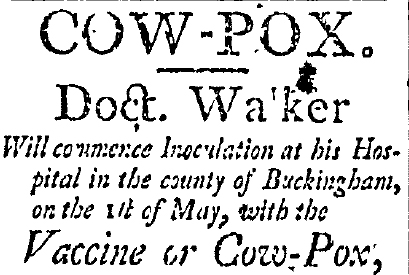
In 2017, a post at Slate River Ramblings featured an advertisement by a Dr. Walker who was offering inoculations against smallpox in Buckingham County. Click here to read the advertisement: Buckingham County: Cow-Pox.
At that time, Slate River Ramblings reader, John Jones wrote: “Walker’s medical practice was apparently centered near Walker’s Church, which is now in Appomattox Co. I believe he did advertise smallpox vaccinations.”
Steve Craig, another blog follower, also recognized the doctor and wrote:
Dr. Walker was indeed Dr. James Walker, son of Maj. Henry Walker and Martha Jones. Her second husband was Capt. Dick Holland. Dr. Walker never married and appears to have died about 1814 (last year he paid tax on his 400 acre tract in Buckingham—four miles west of Buckingham County courthouse).
Steve went on to note that the land was willed to Dr. Walker’s half-brother, Richard “Dick” Holland, Jr., who died in 1819. John Morris, who married Richard’s sister, Nancy Holland, then purchased the tract. In 1846, the farm was described as Mt. Rush. The house, now owned by the Ellis family, is believed to have been built in 1804 and, apparently, was originally Dr. Walker’s home.
John and Nancy (Holland) Morris are Steven Craig’s 4x great grandparents and are the subject of his book, Along the Willis River: Descendants of Nathaniel & Nancy (Jeffries) Morris.
It is for sale by Historic Buckingham.
Coming next: Buckingham Houses: Mt. Rush, Part One


 slate river ramblings . . . .