

This month, Buckingham Notable Louise Harrison McCraw will be posthumously honored by the Library of Virginia as one of 2017’s Virginia Women in History.
Louise Harrison McCraw (1893–1975) was born in Buckingham County at the McCraw homeplace, The Pines, near Andersonville. From the age of five, Louise knew she wanted to be a writer. In 1911, she graduated from the Woman’s College of Richmond with a Bachelor of Letters degree. By 1920, she was a Grammar School teacher in Buckingham  and, sometime before 1925, Louise returned to Richmond where she and her sister, Elizabeth “Bessie” McCraw (1888–1941), lived in a boarding house on Park Ave. in the city’s Fan District. Bessie worked as a hospital nurse and Louise became a librarian.
As co-founder of Richmond’s Braille Circulating Library and the author of a dozen inspirational novels, Louise positively impacted thousands of people during her lifetime and left a legacy of service that deserves recognition.
You can read more about her in this month’s Buckingham Beacon. If you aren’t able to pick up a copy, you can download a PDF at Fluvanna Review.
The award ceremony and reception will take place on Thursday evening, March 30th, at the Library of Virginia, 800 East Broad Street, Richmond. There is no charge for the event. Visit the Library’s website for detailed information:
This post at Slate River includes a short biography and a list of the novels of Louise Harrison McCraw:
Buckingham Notables: Louise Harrison McCraw
You can also learn much more about Louise Harrison McCraw and her “Life of Service” in my book:
“At a Place Called Buckingham,” Volume Two (Slate River Press, 2015).

The following humor piece ran in The Farmville Mercury (published 1873-1881) on March 5, 1874.
BUCKINGHAM MEN.
They are strong, staunch, steady, stayed, stout, strapping, swift, spry, spruce, sprightly, smiling, smart, spirited, spunky, shiny, showy, sparkling, spicy, supportive, superlative, slightly, suitable, serviceable, well made, sized and shaped man, with steps free from strain, sprain, spavin, secretion, or sickness of any sort.
CUMBERLAND MEN.
They are spur-galled, star-footed, string-halted, slight-carcassed, saddle-backed, shell-toothed, short-winded, slab-sided men, they slip, start, stop, shake, shackle, strike, and stop in stall or stable.
The above description was repeated to me by the inimitable Sam, the famous Buckingham joker. Thinking it might be relished by the public I send it to your paper. Mr. Jas. S. Garnett who claims to be the originator of the above is a man of brilliant wit, and has always on hand an endless fund of admirable jokes; he was a gallant soldier, and lost a limb at “Cedar Mountain.” The old man would not consent to my sending his description to print unless I suggested that it might be the means whereby he could procure himself a wife, an article of house furniture he has been craving for, these many years. His face beamed up while I spoke, and he said, “You just put at the end of that thar piece if any middle aged female, who owns a yoke of oxen, in her own right, and wants Sam, all she has to do is to signify the same in a few lines directed to Gravel Hill, and she can git the original sure.”
J.E.H.
Sent from “Saratoga,” on February 12, 1874.
~
“Saratoga” was owned by the Hubard family.
If a Slate River ramblings reader knows more about Mr. James S. “Sam” Garnett, please comment.
Interested in reading more in The Farmville Mercury?
Visit: Virginia Chronicle at the Library of Virginia

In the days when correspondents provided the news of Buckingham County to The Farmville Herald the often diverse tidbits both informed and amused. These were printed in the May 20, 1910 issue of the newspaper.
From Sheppards.
Buckingham has six automobiles to Prince Edward’s three. And I heard it said that the two prettiest girls at the Normal [School] were Buckingham girls. So we can crow a little over Prince Edward even if you do beat us in some respects. . . .
The new macadam road is alright throughout, and we feel when we drive over it that we are “almost persuaded” to wish we lived in Prince Edward.
From Buckingham [Court House].
Strawberries and strawberry ice cream are the delicacies of the season and there is a bountiful of both, though the winter has been most too cold for one to want ice.
Some garden truck was stung by the two frosts we had last week. . . .
Our Arvonia people want a $10,000 high school building, and they are amply able to have it if they go to work about it in the right way. . . .
The girlfriends of the Buckingham baseball team helped them in an entertainment here on the 10th and they made quite a neat sum to be spent in outfits for the ballplayers.
In the May 20, 1910 issue of The Farmville Herald, correspondents contemplated what the census enumerators had learned about the population of Buckingham and its neighboring counties or, from the point of view of Farmville, readers were interested in:
“News of Prince Edward and Adjoining Counties.”
From Sheppards.
May 17th, ’10 –
Everybody is asking about the census figures, but the enumerators are forbidden to tell you how many people they found. Still we can form some sort of idea by referring to the figures as published in former years. We find that in 1880 Prince Edward had 14,668 people, in 1900, 15,045; a gain of 377. Cumberland in 1880 had 10,540 people, and in 1900, 8,996; a loss of 1,544. Buckingham had in 1880, 15,540 and in 1900, 15,226, a loss of 274. Now with these figures staring us in the face we ask what is the matter? How shall we induce emigrants to settle in our counties, and how to keep her own young men from going away. My remedy is to make better roads and better schools. About the first question a prospective settler asks is: “what sort of roads have you? and how about the public schools?
From Buckingham [Court House].
The census takers have been quite diligent in searching out the school population, and this census will have to be completed in May. The clerks of the district boards take this census for which they are paid three dollars for each 100 children.
Strawberries and strawberry ice cream are the delicacies of the season and there is a bountiful supply of both, though the winter has been most too cold for one to want ice. Some garden truck was stung by the two frosts we had last week. . . .
Our Arvonia people want a $10,000 high school building, and they are amply able to have it if they go to work about it in the right way. . . . The girlfriends of the Buckingham baseball team helped them in an entertainment here on the 10th and they made quite a neat sum to be spent in outfits for the ballplayers.

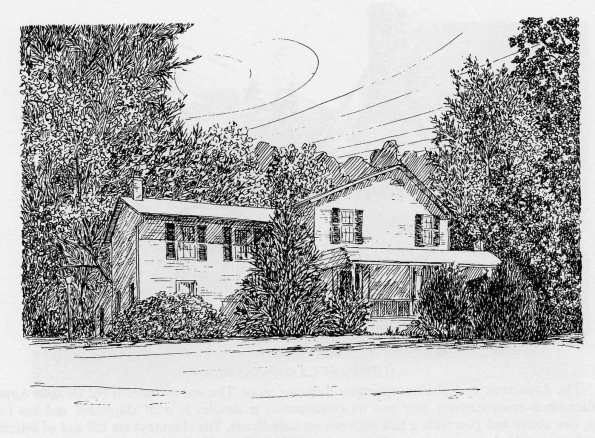
Courtesy Historic Buckingham, Sketch by Margaret Allen Pennington
According to the survey of “Buffalo,” written by Rosa G. Williams, for the Virginia Historical Inventory, the farm was located 6.25 miles east of Sprouses Corner on Hwy 60, thence 2.2 miles north on Route No. 628. Mrs. Williams noted that a date on the chimney indicated that Buffalo could have been built as early as 1770. At one time it was the home of Dr. and Mrs. Bryce McClellan Pratt, who owned about 950 acres, though the original tract may have contained as many as 1,700 acres.
Click here for more about Dr. Pratt, Buckingham County Clerk.
Slate River Ramblings’ reader Mary Carolyn Mitton recalled, “In about 1890, there was a great deal of interest in the mineral deposits in this section, and hundreds of acres of land were bought by speculators and others. This property was bought by Chas. F. Reifsnider, a promoter of the mining industry, who owned it for some years.”
Mary Carolyn Minton also shared this description of Buffalo, written in 1940:
This once fine old house is close to the highway. The original entrance to the yard in front of the house has been changed with the public road to the side yard. One notices two very large holly trees in the yard as well as the other old shade trees. The one story front porch is the original porch, only the steps are new. The two columns on the porch are small with lattice work between them, thus making one column. The large front door has side lights. These are of small diamond shaped glass. One or two have been broken, otherwise they are the original. The square hall with wide easy steps gives one the impression of space. There is a large room on each side of the hall, each one (is) twenty feet square. Each has a large fire place and a high narrow mantel. On the six panel doors are fine old iron locks with small brass knobs. The locks bear the stamp of England, showing the Royal Coat of Arms. The lock on the back hall door is 14 inches long and 7 inches wide. There are ten rooms, a basement, many closets and three porches to the house, which is only one and a half stories high. Several rooms have wainscoting and others have chair rail.
Just when the house was built could not be definitely determined. Mrs. Pratt, of Buckingham Court House, Virginia says she visited the home when she was a mere child, and that the house was old then. She is now 85. (1940) The present owner says his father, who is 87 years old, has known the place all of his life and that he does not know when it was built, nor did his father before him. There are several dates and initials out on one of the old rock chimneys. What they signify is not known. Only a few could be read as:
J.D.T. May 12, 1840
T.R.T. 1842

In 1866, after the Surrender at Appomattox and before the courthouse fire in Buckingham County, Dr. Bryce McClellan Pratt was appointed County Clerk of Buckingham County, Virginia by the occupying military.
Born in Maine, Dr. Pratt was already a long time resident of the county. He graduated from Jefferson Medical College (Philadelphia, Pennsylvania) in 1844, settled in Buckingham that same year, and married Emeline Frances Trent on April 13, 1848. Rev. J. H. Fitzgerald officiated at “Clay Bank.”
In about 1872, he and his family left for the west, eventually settling in Bentonville, Arkansas. Like many Buckingham families, his financial troubles deepened following the Civil War.
In January 1871, Nicholas Flood Bocock filed suit against Dr. Pratt in the Buckingham County Court. The physician declared bankruptcy and his farm, “Buffalo,” was sold at public auction. The announcement read in Richmond’s The Daily State Journal:
JOINT SALE OF ASSIGNEE
OF
OF VALUABLE REAL ESTATE IN
BUCKINGHAM COUNTY, AT PUBLIC AUCTION
By virtue of an order of the United States District Court for the Eastern District of Virginia, dated August 27th, 1872, I will sell as assignee of Bryce M. Pratt, bankrupt, on TUESDAY, SEPTEMBER 24th, in front of the United States Court-House, in the city of Richmond, at 3 P.M., that valuable tract of land containing a tract of land containing 786 ACRES, in Buckingham county, Va., with Dwelling-House, School-House, Office, Barns, Carriage-House, and Ice-House on same, all in good repair.
This land is adapted to grain, grass, tobacco, &c. This land will be sold in lots or parcels to suit purchasers.
TERMS-One-third cash; balance on a credit of six and twelve months, the purchaser to give notes for the deferred payments, interest added, title retained by the assignee until said notes are paid.
Wm. B. Matthews, Assignee.
Sept. 3d, 1872.
Does a Slate River Ramblings reader know which school house sat on the Pratt property?
Many thanks to Mary Carolyn Mitton for this information about her great-great grandfather, one time Clerk of Buckingham County.
Coming Next: Buckingham Houses: Buffalo
Courtesy Historic Buckingham, Sketch by Margaret Allen Pennington
In 1871, Joseph Fuqua advertised the sale of his estate, Bear Garden, located near New Canton, in the northeastern corner of Buckingham County:
BEAR GARDEN FOR SALE –
The subscriber wishes to sell the estate on which he resides, known by the name of Bear Garden, lying in the lower end of the county of Buckingham, on James River, immediately below the town of New Canton, containing about eight hundred and twenty-five (825) acres, of which there are about one hundred and ninety acres first-rate James River low ground. The high land is good and is in improved condition. There is on this farm a good grist and plaster mill in good order, with cast-iron gearing, on a never failing stream. The neighborhood is as good as any – is convenient to the canal, and is sixty-six miles above Richmond by the canal. It is believed that the straight-shoot railroad from Clifton Forge, on the Chesapeake and Ohio Railroad to Richmond, will pass through this immediate neighborhood.
The subscriber will also sell another tract of land lying north, in six miles of Bear Garden, containing about 385 acres, all in woods. If the sold lands be not sold privately by TUESDAY, the 1st day of August next, they will be offered for sale at public auction on that day, and the town of New Canton. All persons wishing to purchase such property, are invited to view the same and judge for themselves.
JOSEPH FUGUA
For more about life at Bear Garden see: Runaway Slave: Patrick Winfrey

Advertisements for runaway slaves naturally included physical characteristics of the missing person and now antiquated descriptions for skin tone. Patrick Winfrey, the property of Joseph Fuqua, was described as “a tolerably bright mulatto” – a fair-skinned African American. In the case of Patrick Winfrey, he may have headed north, towards freedom. Other slaves often escaped, attempting to rejoin family members from which they had been separated. The following advertisement ran in June of 1848. Patrick Winfrey’s fate is unknown.
25 Dollars Reward.
RAN AWAY from the subscriber, living near New Canton, Buckingham County, on 28 December last, a Negro Man named PATRICK, about twenty-three years of age. He sometimes calls himself Patrick Winfrey, and I understand frequently calls himself Winfrey. He is a tolerably bright mulatto, and when he left home had a bushy head of hair. He is about five feet eight or ten inches high. No scar remembered, but my overseer informs me that, when he left, he had a small bump over one of his eyes, but whether it was a stye or other injury he doesn’t know. His Winter coat was of napt-cotton, his pantaloons of homespun, and his hat a white wool hat, but it is believed he has traded off his coat and hat, and wears a frock coat and cap. It is believed he is making his way to Ohio, and may be in company with another. I have heard he has free papers. The above reward will be paid to anyone who will apprehend him and deliver him to me, or confine him in jail so that I can get him.
JOSEPH FUQUA.
Bear Garden, Buckingham co.
~
Interested in learning more about the use of newspaper advertisements to reclaim runway slaves?
Visit “The Geography of Slavery in Virginia”
Coming next: For Sale: Bear Garden
During the 18th and 19th centuries, newspapers frequently printed advertisements for runaway slaves. The rewards which offered descriptions of these desperate men and women increase our understanding of the sufferings of slavery. Through these advertisements, we are often reminded that many slaves used surnames long before Emancipation. In this case, Nelson Hart was the property of Elizabeth Ann Price of New Canton, Buckingham County and his surname, “Hart,” was established before he was purchased by Price. It is also often disclosed that skilled men such as Nelson Hart frequently traveled far from home, resulting in a wide knowledge of Virginia. Nelson Hart’s fate is unknown. The following advertisement ran in the spring of 1847:
$15 REWARD.
RUNAWAY from subscriber some time ago, a negro man named NELSON HART, of dark complexion, about five feet eight inches high – with one Eye out, which [one], not recollected – he is about 35 or 40 years of age – quite intelligent – took with him a suit of black summer clothes and a suit of Kentucky Jeans – one of the Coats has a Velvet Collar. Nelson has been hired for a number of years at the Buckingham Iron Works, both at “Bear Garden” and “Stone Wall” – has attended Furnaces over the Mountains, his acquaintance is very extensive. The above reward will be paid for his delivery, or his security in Jail so that I might get him.
ELIZABETH ANN PRICE,
New Canton, P. O., Buckingham co., Va.
~
Interested in learning more about the use of newspaper advertisements to reclaim runway slaves?
Visit “The Geography of Slavery in Virginia”
Coming next: Runaway Slave: Patrick Winfrey

The Richmond Whig, Courtesy Virginia Memory, Library of Virginia
When the Buckingham Courthouse burned in February of 1869, James Woodfin needed to reestablish his purchase of land from Garland Brown in 1841. The following announcement appeared in The Richmond Whig in the summer of 1869.
The petition of James Woodfin this day filed before me represents that on – day of August, 1841, Garland Brown sold and conveyed, with general warranty, by deed duly executed and delivered to him, the petitioner, a track of land of (255) two hundred and fifty five acres, lying and being in the county of Buckingham, adjoining the lands of the petitioner and others; that shortly thereafter the said deed was recorded according to law in the clerk’s office of the county court of Buckingham county; and said record, together with the original deed, has been destroyed by fire, and prays that a time and date may be appointed for taking proof to re-establish the said record.
Apparently, Garland Brown was no longer a resident of the State of Virginia. The notice in the newspaper requested him to appear before Robert T. Hubbard Jr., on 13 July 1869, at his office at Buckingham Court House.
In the same issue of the paper, a second notice appeared concerning James Woodfin’s purchase of 30 acres from John J. Brown in 1853. Mr. John J. Brown, apparently a non-resident of the State of Virginia, was also requested to appear at Hubbard’s office.
How did James Woodfin come to lose his own copies of these deeds? Did the Browns appear as requested?
To learn much more about the burning of Buckingham Courthouse, please consult: “Incalculable Loss: The Burning of Buckingham Courthouse” in “At a Place Called Buckingham.”


 slate river ramblings . . . .