
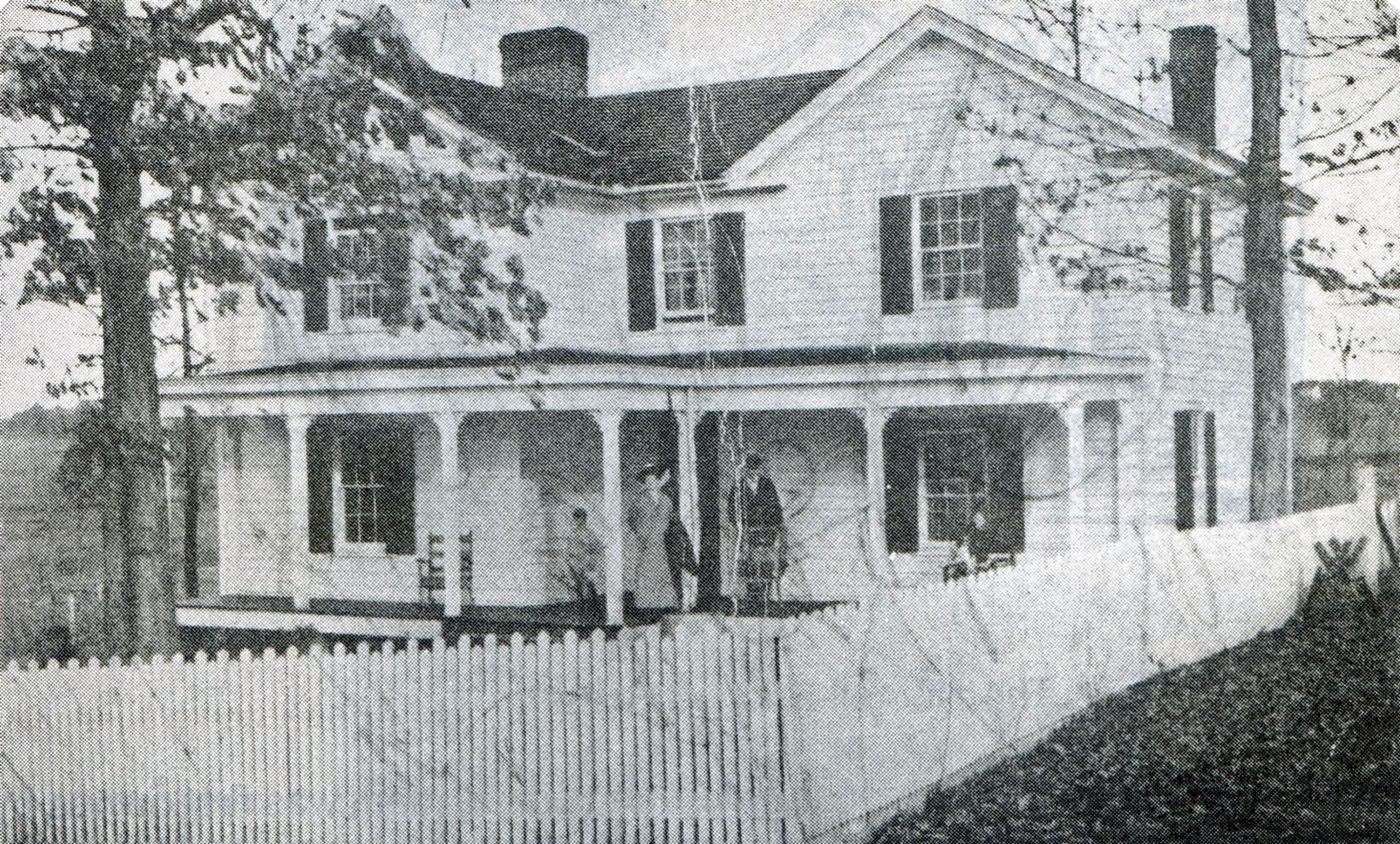
“The Culbreth Hotel”
Photo Courtesy Ernest Wright and A Pictorial History of the Town of Dillwyn, VA
According to The Courthouse Burned — by Margaret A. Pennington and Lorna S. Scott, Mrs. Patty Pryor was the first proprietress of the original Old Dominion Inn. That building burned to the ground and the white clapboard house pictured above was built in its place on Main Street in Dillwyn, Buckingham County. Miss Dolly Hooper became the proprietress of the new Old Dominion Inn. On December 16, 1903, she married Mr. Henry Clay Culbreth, a Maryland native and fruit broker, who spent much of the year in Florida.
By June of 1908 (and likely before), Dolly’s establishment was known as the Culbreth Hotel when the following was mentioned in Richmond’s The Times Dispatch:
Miss Sara Page is the guest of Mrs. E.L. Driscoll at Culbreth, Dillwyn, Va.
On the 1910 Federal census, Dolly’s home was described as a boarding house. Mary Chambers was Dolly’s live-in cook. Mrs. Culbreth also employed a butler, Grant Logan, and a maid, Carrie Spencer, to serve her customers.
The family pictured in the postcard above is believed to be Dolly, her husband, and children. She and Mr. Culbreth had three children: Harry (born 1904), Jim (born 1907), and Frances (born November 1912). If Frances is in the baby buggy, the photo was taken about 1913.
In 1932, Mrs. H. M. Culbreth was listed with Mrs. F. S. Spencer and Mrs. Gladys Camden as a contributor to The Farmville Herald. Her grand-nephew, Harry S. Holman, remembers her as a regal and well-educated woman, fully capable of sending articles to the newspaper while tending to her guests at the Culbreth Hotel.

Henrietta Moseley (Hooper) Culbreth (1881–1976)
Courtesy Harry S. Holman and The Holmans of Virginia
Last September, the Slate River Ramblings post concerning Buckingham County Correspondents to The Farmville Herald inspired a lively conversation. One of the regular contributors listed a Mrs. H. M. Culbreth.
Harry S. Holman writes that Mrs. Henry Clay Culbreth was born Henrietta Moseley Hooper in Buckingham County at Hooper’s Mountain, two miles west of Willis Mountain. Affectionately known as “Dolly,” she was the daughter of Powell and Willie Ann (Holman) Hooper, attended Carterville Academy in Cumberland County, and continued her education at a business college in Richmond. She returned to Buckingham and went to work as a stenographer for the enterprising Mr. H. M. White, one of the founders of White Hall (later Dillwyn).
To be continued . . . .
 GOLD! GOLD! GOLD!
In 1856, something was stirring in Buckingham County.
A significant number of valuable Buckingham farms and other businesses were advertised for sale in the Richmond newspapers. Did sellers attempt to take advantage of a strong market? Did they anticipate a dip? Was the climate in Buckingham shifting towards increasing industry, making those properties more valuable? Did the political battles over the Kansas Territory concern Buckingham County slaveholders? Was it just coincidental? Along with several farms, a gold mine was for sale.
VALUABLE GOLD MINE AND MACHINERY FOR SALE –
In pursuance of a decree of the Circuit Court of Buckingham county, rendered on the 19th day of September 1855, in a suit in chancery, in which Frederick Wiseman, is plaintiff, and Buckingham Gold Company, and other defendants, I shall offer for sale at Buckingham Court House, Virginia, at public auction . . . a tract of land containing 292 acres, on which is the Gold Mine, commonly known as the Buckingham Mine, together with Machinery and fixtures. The Mine is situated in the County of Buckingham, within 7 miles of the Court House, and adjoins the London and Va. Gold and Copper Mining Company, and has always been considered on the of the most valuable in the State.
The advertisement goes on to say that the engine and machinery were erected and “a tunnel constructed at great expense.” To encourage buyers, the ad stated that the operation could be running at very little additional expense.
W.W. Forbes, Sheriff of Buckingham County, handled the sale.
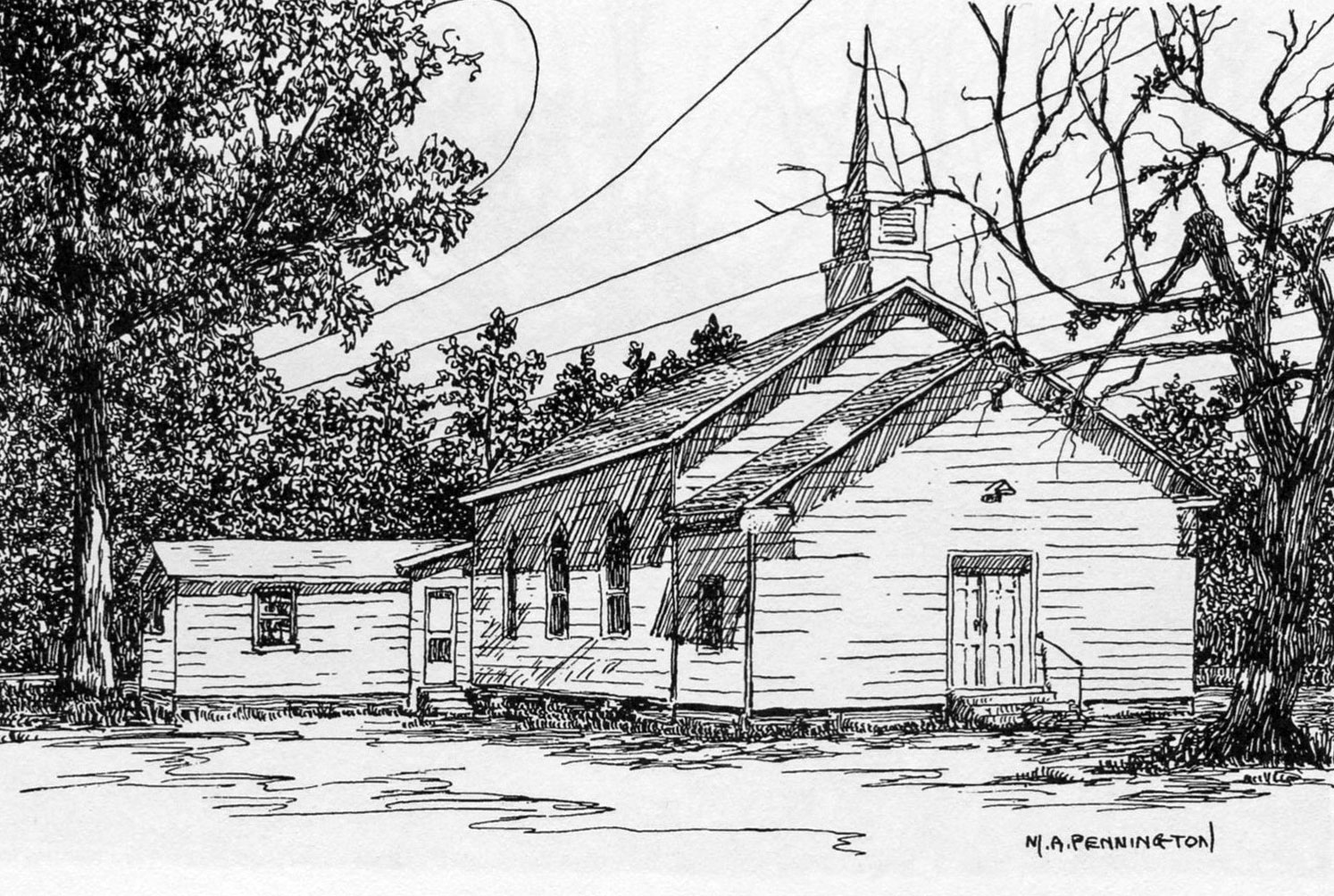
Goshen Baptist Church, Courtesy Historic Buckingham
This building replaced the original structure on the same site.
The Virginia Historical Surveys from the 1930s are a wonderful resource, truly invaluable. Many, however, include misleading content. Some errors are to be expected, especially when gathering oral history. Other mistakes may be the result of typists deciphering the handwriting of Buckingham County field workers Elizabeth McCraw and Garnett Williams.
When Mrs. Williams surveyed the site of Goshen Baptist Church, the long-destroyed building was given the date “1838.” Since the church was founded in 1858, it seems likely that Garnett Williams’ “5” was interpreted as a “3” by the typist, thus creating the misleading date.
According to the survey, the first Goshen Baptist Church was torn down in 1888. Because the structure was no longer standing in 1937, Garnett Williams noted under “Historical Significance” that the church was “said to have been very poorly constructed.”
Informants mentioned were Buckingham historian Lulie Patteson, described by Garnett Williams as “an old inhabitant” of the county, and Lucy Hocker, an “elderly colored woman” living in Warren.
Originally, Goshen was known as Gooseberry Baptist Church and one of the church founders was Rev. Elbridge G. Jefferson, grandson of Randolph Jefferson and great-nephew of Thomas Jefferson. No mention of the Jefferson connection was made in Mrs. Williams’ survey. Perhaps, Rev. Jefferson, who died on September 10, 1865, was long-forgotten in Buckingham County. While he had three children, none of them left descendants.
Click here to search the Virginia Historical Surveys, available online at the Library of Virginia.
To learn more about WPA field workers Elizabeth McCraw and Garnett Williams, as well as historian Lulie Patteson, consult “At a Place Called Buckingham.”
 Thanks to my friends at Scottsville Museum, you can download a PDF of “The President’s Brother: Capt. Randolph Jefferson of Buckingham County, Virginia.” Just click on the title.
Of course, there is a whole lot more to Randolph Jefferson’s story to be found in The Jefferson Brothers.
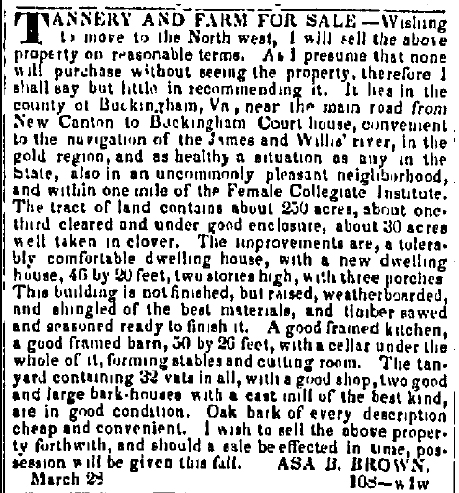
In 1837, Asa B. Brown, one of the trustees of the Buckingham Female Collegiate Institute, advertised his Farm and Tannery for sale in the Richmond newspapers. Located near The Institute, the advertisement described Buckingham County as a healthy and pleasant place to live.
TANNERY AND FARM FOR SALE – Wishing to move to the Northwest, I will sell the above property on reasonable terms. As I presume that none will purchase without seeing the property, therefore I shall say but little in recommending it. It lies in the county of Buckingham, Va, near the main road from New Canton to Buckingham Courthouse, convenient to the navigation of the James and Willis’ river, in the gold region, and as healthy a situation as any in the State, also in an uncommonly pleasant neighborhood, and within one mile of the Female Collegiate Institute. The tract of land contains about 250 acres, about one-third cleared and under good enclosure, about 20 acres well taken in clover. The improvements are, a tolerably comfortable dwelling house, with a new dwelling house, 40 by 20 feet, two stories high, with three porches. This building is not finished, but raised, weatherboarded, and shingled of the best materials, and timber sawed and seasoned ready to finish it. A good framed kitchen, a good framed barn, 50 by 26 feet, with a cellar under the whole of it, forming stables and cutting room. The tanyard containing 32 vats in all, with a good shop, two good and large bark-houses with a cast mill of the best kind, are in good condition. Oak bark of every description cheap and convenient. I wish to sell the above property forthwith, and should a sale be effected in time, possession will be given this fall.
ASA B. BROWN, March 28.
Why did Asa Brown decide to sell just when he was building a new dwelling house? Why go north? Did he successfully make the move? In 1840, one man named Asa B. Brown is living in La Porte, Indiana. Another is living in Kalamazoo, Michigan.
Does a Slate River Ramblings reader know more about Asa B. Brown’s story?

Trinity Presbyterian Church, Photo by Joanne Yeck
In 2013, I set out to discover the nineteen Buckingham County churches referred to (but not named) in Thomas Baldwin’s Gazetteer of the United States (1854). Thus far, eighteen candidates for the churches and chapels have been identified. Listed below, they have been featured over many months in posts at Slate River Ramblings. Click on the church name to read the post.
Can a Slate River Ramblings reader help identify the ninetieth church or chapel active in the Buckingham County in 1854?
Could the former Anglican Church known as Goodwin’s Church have continued into the 19th century as an Episcopal Church and be number nineteen?
In 1853, the following US Mail Route was described: “From Howardsville, by Goodwin’s Church and Mount Vinco, to Buckingham C.H., 18 miles and back once a week.” Apparently, Goodwin’s Church was still standing but was there an active congregation?
Three Methodist Chapels: Jones, Lebanon, and Stony Point
Trinity Methodist Episcopal Church

Winfrey Store and Post Office (2007), Photo by Jeremy Winfrey
The first Postmaster of Well Water in Buckingham County was Frank N. Maxey who established a mill and a small collection of services at his farm called Well Water in northern Buckingham County. He was appointed Postmaster on December 31, 1858.
John R. Agee, George D. Maxey, John C. Turner, Jr., Robert M. Agee, and Samuella W. Maxey spent time in the job. F.N. Maxey’s second wife, Alice (Spencer) Maxey, also acted as Postmistress.
On December 6, 1905, Annie E. Tapscott (1878–1972) took over the position. As a married woman, she continued at her job as Postmistress from August 13, 1912 to December 31, 1943, when the Post Office closed and Annie retired. Beginning in 1944, Well Water’s mail was processed at Wealthia.
Prior to her marriage in 1910, Annie taught school. She and her husband, Harvey St. Elmo Winfrey (1874–1955), also operated a store at their farm.

In 1854, Thomas Baldwin’s Gazetteer of the United States counted nineteen active churches in Buckingham County. Fifteen likely candidates have been identified in previous posts at Slate River Ramblings. The three Methodist Chapels identified below, all with active congregations in 1853, may be numbers sixteen, seventeen, and eighteen.
First is Jones Methodist Chapel, location currently unknown. In 1853, the Class Leader was William B. Jones. At that time, there were only ten additional members in the Class at Jones Chapel.
Second is Lebanon Methodist Chapel, location also unknown, though the surnames in the congregation indicate it was likely in northeastern Buckingham County. In 1853, the Class Leader was M.L. Ayres and fellow members included Moseleys, Bransfords, Maxeys, Agees, Babers, Robertsons, and Bagbys.
Third is Stony Point Methodist Chapel. Elijah Hanes, founder of Humanity Hall Academy, helped establish this chapel located about a mile northeast of Humanity Hall. In 1853, Hanes served as both Class Leader and Steward. His wife, Judith, and his children, including Garland B. and James C. Hanes, joined him in worship there.
In 1859, Hanes Chapel, replaced Stony Point. Erected in Elijah G. Hanes’ honor, it was constructed about a half mile east of the Academy. Some members of Lebanon transferred to Hanes Chapel, indicating close proximity of the two locations.
To be continued . . . .

The Historic Buckingham, Inc. 2015 Calendar makes a great gift.
There’s more than one way to enjoy Buckingham County history!
In Buckingham, you can purchase copies of the 2015 Calendar at Dillwyn Pharmacy, Housewright Museum, The Historic Village at Lee Wayside, and at Nancy’s Gift Shop.
Price: $8.00.
If you aren’t near Buckingham County, send a check for $10.00, the price of the calendar plus postage, to: Historic Buckingham, PO Box 152, Buckingham, VA 23931.


 slate river ramblings . . . .