
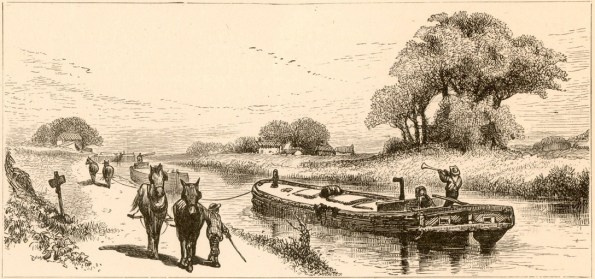
Canal Travel.
Need to catch up? Click here: Buckingham County: Rebuttals to an Inlet at Perkins’ Falls, Part I
Unfortunately for the citizens of central Buckingham County, the Directors of the James River and Kanawha Canal Company did not create access at any of the locations suggested. Left without a central bridge, farmers along Slate River had no choice but to haul their product by wagon to New Canton where they could cross the bridge to the canal. Or use the ferries at Warren, Scottsville or Bolling’s Landing.
Scottsville historian Richard Nicholas helped clarify the situation: “There were only three southside connection bridges on the entire canal: Duiguidsville (Bent Creek), Hardwickesville (Wingina) and New Canton, leaving most of the farmers on the south side of the river cut off from the canal with no easy access. The canal company might have almost doubled their traffic by expanding access to those on the south who wanted to ship on the canal.”
Other Slate River Ramblings followers wondered about the exact location of Perkins’ Falls. Richard Nicholas suggested, “If Perkins’ Falls was 12 miles north of Hocker’s Mill on the James River, it was approximately someplace between Howardsville and Warren.”
If Perkins’ Falls was near Hardwickesville, the proposal doesn’t seem to make sense when there was a bridge there.
Can a Slate River Ramblings reader help with the exact location of Perkins’ Falls?

Richmond Enquirer. Courtesy Virginia Chronicle.
Need to catch up? Click here: Buckingham County: Rebuttals to an Inlet at Perkins’ Falls, Part I
The next letter in the Richmond Enquirer read as follows:
To the Directors of the James River and Kanawha Company.
We see in the Whig of the 7th a communication directed to you, urging the importance of an inlet to the Canal. We think that it is high time the inlet was made, for we have suffered long enough; but we cannot agree that Perkins’ Falls, is the most central place, nor do we think that the majority of the farmers wish it to be put at Perkins’ Falls — although some few, immediately interested in Perkins’ Falls, have been zealous in getting up a memorial, and have produced a number of signatures. We have never seen the memorial, and it certainly ought to have been presented to us for we reside nearer Perkins’ Falls than some persons whose names we hear are on the memorial — and, if we have been rightly informed, the signers of the memorial hail from the neighborhood of Bent Creek, Slate River and the low end of the county. Allow the inlet to be made at Perkins’ Falls, and you have no accommodations; the country will be taxed to make roads there. We see no necessity for this. In all common sense we have taxes enough to bear — Why not have the inlet that Warren Ferry, where all would be benefited; were good roads are already made on both sides of the river? — We firmly believe, if the vote was taken at the Court-house, Warren Ferry would get two to one. We have never troubled you with a memorial — knowing that the routes have been surveyed, and having full confidence that you would cause the inlet to be made where it would most promote the interest of the farmers and the canal.
We also see a communication signed “Buckingham,” setting forth the claim of Scottsville, as a place possessing many advantages to the traveling community, and farmers of the county; stating that they can at all times find ready sales for their produce, and in return get groceries, &c,. as cheap as they can be purchased in Richmond — deducting toll, freight, &c. Now, this may be true; but why make us travel so far from the direct route, when we can do as well in Warren? Let the bridge be put at Warren Ferry, and we can sell every bushel of wheat raised in the country and the town of Warren. The Warren mill is in full operation, and we can do as well with our wheat there, as we could do with it and Scottsville, when sold, we can get the money, and procure our groceries and other family necessities in Warren, as cheap as they can be purchased in any town this side of Richmond.
MANY FARMERS OF BUCKINGHAM
~
Coming Next: Buckingham County: Rebuttals to an Inlet at Perkins’ Falls, Part V
Richmond Enquirer. Courtesy Virginia Chronicle.
Need to catch up? Click here: Buckingham County: Rebuttals to an Inlet at Perkins’ Falls, Part I
~
The citizens of Buckingham County were not satisfied with the suggestions printed in the Richmond Daily Whig and rebuttals continued in the pages of the Richmond Enquirer.
On September 3, 1844, the Enquirer printed to letters to the editor addressed to the Directors of the James River and Kanawha Company suggesting other locations for bridges connecting Buckingham County to Albemarle County and the canal.
FOR THE EDITOR.
To the President and Directors of the James River and Kanawha Company.
In the Whig of the 7th inst. is an article addressed to you, urging the establishment of an inlet to the canal from the Buckingham side, and recommending Perkins’ Falls as a suitable location; also, in the Whig of the 16th inst. is another communication recommending Scottsdale as a suitable location. While the subject is in agitation, I will suggest another point on the river viz: Fallsburg Mills as a suitable location for an inlet or bridge which is to be selected between New Canton and Hardwick’s. It being near the centre between the two places, it will accommodate a large district of the country, in which a large quantity of Tobacco and Wheat is produced. It would also be equally near to Hocker’s Mills as Warren Ferry or Perkins’ Falls — and a good deal nearer to Scottsville, the other place recommended and it has the advantage of a fine road leading to it on the Buckingham site, and the hill at the river very easy to ascend and descend. It is thought the bridge could be built at Fallsburg for a less some that at either of the other points; as timber and rock are very convenient, and the location being at the Falls, it will have a good foundation, and less liable to be washed away. The neighborhood of Hardwick’s is already accommodated with the ferry which carries over the produce, &c., to and from the canal at the company’s expense; and the lower section, between Slate River and James River, are accommodated at Bolling’s Landing, at a very small expense; while the middle section of Goodwin’s Church and surrounding country labor under great inconvenience and expense, in getting their produce to market. We hope you will do us the justice to fix the location of our inlet immediately, or make such arrangements with the owner of the ferry (until the bridge can be built) as has been made at Bent Creek, Hardwick’s and N. Canton.
WALTON’S FORK.
Whig requested to copy.
~
For more about Fallsburg Mills in the Slate River Ramblings archive, follow these links:
Fallsburg Mills: Parts III – V
~
Coming next: Buckingham County: Rebuttals to an Inlet at Perkins’ Falls, Part IV
Richmond Daily Whig. Courtesy Virginia Chronicle.
Need to catch up? Click here: Buckingham County: Rebuttals to an Inlet at Perkins’ Falls, Part I
~
The proposal printed in the August 16, 1844 issue of the Richmond Daily Whig, suggesting Scottsville as a preferable for a bridge and access to the canal, continued as follows:
Fourth. To most persons living nearer Perkins’ Falls that Scottsville, and inlet at the latter place would be equally as convenient as at the Falls, for a large portion of them would, for the reasons here given, prefer shipping at Scottsville in either case; and the only difference would be, that in one case they would travel from Perkins’ Falls to Scottsville on the North side of the river — and in the other, the same or a less distance on the South. Scottsville is, I believe, as central to the district of country interested as Perkins’ Falls; at any rate, there cannot be much difference between the two places in this respect, is there distance apart is only three miles; and I would ask whether the advantages of Scottsville, as a place for selling or shipping produce would not far more than compensate for a trivial increase of distance?
Fifth. If the company build a bridge at Scottsville, that town would, I have been informed, be willing to contribute a considerable proportion of its cost, and the tolls received from the travel across it would perhaps more than repay the outlay for its erection. You are aware that there is a permanent line of stages between Scottsville and Staunton, and if a bridge were made, the travel from the South side thro’ Scottsville would doubtless be great, and increased still more, should the efforts now being made to get the Scottsville and Staunton Turnpike McAdamized meet with the success confidently anticipated by the advocates of that improvement.
Believing that you will give the subject your early and impartial attention, I would only remark further, that it is thought with good reason, that if all people in that portion of the county interested were applied to, far more signatures would be obtained to a petition in favor of Scottsville than any other location.
BUCKINGHAM.
Coming next: Buckingham County: Rebuttals to an Inlet at Perkins’ Falls, Part III
Richmond Daily Whig. Courtesy Virginia Chronicle.
In May 2019, Slate River Ramblings ran a series entitled, “Buckingham County: An Inlet at Perkins’ Falls.”
Click here to read the original posts: Buckingham County: An Inlet at Perkins’ Falls, Part I
~
The series was based in a letter sent from “Many on Slate River” to the editor of the Richmond Daily Whig in August of 1844. The authors stated that the James River and Kanawha Canal Company had promised access to the canal from a central point in Buckingham County. A rebuttal followed in the Whig on August 16, 1844, arguing that Scottsville rather than Perkins’ Falls was the obvious choice to build a bridge. This letter, signed simply BUCKINGHAM, begins like this:
TO THE DIRECTORS OF THE JAMES RIVER AND KANAWHA COMPANY.
In the Whig of the 7th inst, is an article addressed to you urging the establishment of an inlet to the canal from the Buckingham side, and recommending Perkins’ Falls as a suitable location. The only advantage claimed for this place over the town of Scottsville is, that it is a little nearer to Hocker’s Mills, and to a portion of the People for whose benefit the inlet is to be made. I am as willing as any man to sacrifice personal interests when the public good is thereby to be promoted, but in this case I would regretfully suggest a few reasons why it would be best for all, or at least a large majority of the parties concerned, that a bridge should be billed at Scottsville, as I understand has been contemplated by the company.
First. Scottsville being an old established place for crossing the river, there are on both sides, roads approaching it from every direction already open. On the other hand, there are few if any public roads terminating at Perkins’ Falls, and the county would necessarily have to incur the expense of making new ways of access to the latter place.
Second, it can be proved beyond any doubt that Scottsville is, in the aggregate, a good market for the sale of produce and the purchase of groceries and other supplies needed by us, as Richmond, there being no difference in prices except the freight and toll between the two places. — Give us access to Scottsville and we have the great advantage of a market where we can, in person, purchase our supplies, and sell our surplus products, without being taxed with commissions and storage. This consideration alone, I think, ought to outweigh all that can be addressed on the opposite side of the question.
Third. Persons shipping produce at Perkins’ Falls would necessarily have to pay storage, whereas at Scottsville boats can always be found ready to receive it.
Coming Next: Buckingham County: Rebuttals to an Inlet at Perkins’ Falls, Part II

Need to catch up? Click here: Buckingham County: Hyatoga, Part I
~
Upon the death of the stud horse Hyatoga, his owner, John C. Harris of Orange County, promised eager horse breeders on the south side of the James River that Hyatoga’s brother would eventually be available as a substitute. In a postscript to Harris’ description of Hyatoga’s death was published in the following in the Virginia Argus:
To the citizens of the counties in which Hyatoga had commenced his stands this season, Charlotte, Buckingham, Prince Edward &c.
GENTLEMEN,
I make the most serious acknowledgments to you for your most liberal encouragement of my late horse Hyatoga, who had commenced a season among you. I am sincerely sorry that our expectations have been so disappointed, and I regret that it is out of my power to let my other Hyatoga come and take the stance of his Brother, agreeably to the pressing requests of many of you, in consequence of his having met with the most liberal patronage in this part of Va. Next spring, however, he will make a season, & take the stance of his Brother. You may rely on seeing as fine a horse as the other. He is thought by most judges, who have seen both, to move in a stile superior, and to be of equal form and superior size of his age. He is a beautiful Chestnut Sorrel, with white mane and tail, full 16 hands high. He paces with great speed and elegance, and with great ease to his rider.
I am Gentlemen your obdt. Servt.
JOHN C. HARRIS.
Willow Grove, Orange, May 1st 1816.
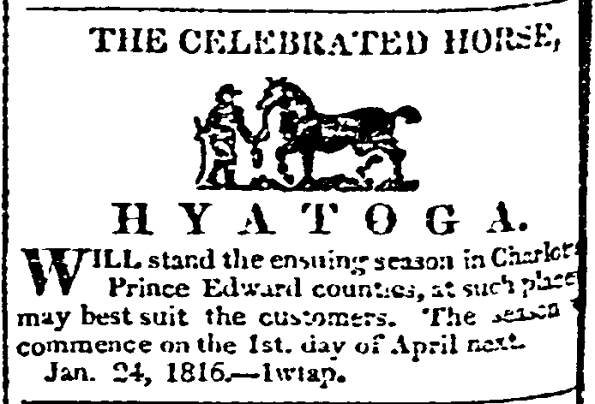
Virginia Argus.
In the early spring of 1816, the Virginia Argus carried an advertisement that the celebrated stud horse named Hyatoga would be available beginning the first day of April in Charlotte and Prince Edward counties. He would also visit Buckingham.
In May, the same newspaper announced Hyatoga’s shocking death. His obituary, much lengthier than afforded many of Virginia’s best known citizens, read as follows:
A Public and Private loss in the Death of the highly celebrated HORSE
HYATOGA.
I think it a duty incumbent on me, to adopt this method of informing the most liberal public of the particulars relative to the death of the much admired & celebrated Horse HYATOGA. He had stood in most of the counties in Virginia and had acquired great applause & celebrity as a Foal-getter. Most of his colts, which are many, remain as specimens, and are sufficient proof of the superiority of the Hyatoga or Naragansett breed for the saddle.
HYATOGA was raised by Capt. Samuel Carr of Albemarle County and was purchased of him by Maj. Stapleton Crutchfield and Dr. James Minor for $2000 when he was 9 or 10 years old. From these two Gentlemen, myself and partner (Mr. Lewis Sherley) purchased him in January last at not much under $2000 in the aggregate tho’ he was in his 16th year.
We moved him South of James River and had fixed his stands, and the most sanguine expectations were entertained of his making a greater season than he had ever made before. He was let to mares at $20 the season, and would, without doubt, have got as many as he could have served at that price. It was the prevailing opinion that he would have had from 152 to 200 brought to him, some of them from a great distance.
The young Gentleman who acted as groom, had fixed his three regular stands at proper distance; one near Charlotte Court-house, one near Buckingham Court-house, and one at Prince Edward Court-house; at all of which stands the most liberal encouragement had been given.
The groom informs me that he never saw him appear more healthy and vigorous than he was on Tuesday, the 23d of April, the day before he died. He informed me that he heard him stamp the floor of his Stable [about] on Wednesday, 24th April, and that he flew to his relief. He found him much complaining, and immediately commenced giving drenches of every thing and kind advisable; but all proved abortive! The envious and deadly draught had been judiciously and effectually given to yield to an antidote. He died about one o’clock on the same day (Wednesday 24th April) at his stand at the Stable of Mr. Garner in Prince Edward Court-house in the 16th year of his age. His sire died in the state of Kentucky in 1814 in his 47th year.
HYATOGA was let to a mare the morning before he died, and, appeared to possess unusual vigor. The groom was offered at the stable door $2,500 for him no more than three weeks before he died.
It being the opinion of many who were present at Hyatoga’s death was occasioned by villainous and unfair means, I will give FIVE HUNDRED DOLLARS, to any person or persons who will apprehend and bring to trial and punishment the villain or villains who may have been the perpetrators of this atrocious deed.
I will inform the Public that there is one more Hyatoga left, who is in my possession, and is brother, to the above Horse and possesses every action, and form of the other. He stands at my stable one mile from Gordonsville in Orange, where good pasturage will be furnished, and great care taken of mares from a distance. All who wish to breed from Hyatoga will do well to embrace this opportunity, as he will leave this part of Va. the next season.
JOHN C. HARRIS.
Willow Grove, Orange, May 1st 1816.
—
John C. Harris’ sad report and offer of a reward was followed by a postscript.
Coming next: Hyatoga, Part II

In 1878, the Alexandria Gazette reported a tragedy in Buckingham County in great detail:
Five Men Drowned.
A correspondent of the Richmond Whig gives the following particulars of the deplorable accident that was mentioned in the telegraphic news in yesterday’s Gazette: — “On Saturday, 16 March, 1868, five good and true men lost their lives by a dreadful accident, the memory of which will never fade from the many hearts, who now, in grief and sorrow, lament their loss. Three men and a boy about sixteen years of age, left their work, as was usual with them, on Saturday evening, to go across the river to the town of Howardsville. They were laborers upon the farm of a gentleman who resided on the Buckingham side of the river. — They returned about 7 p.m., and found no boat upon the Nelson landing, which is situated upon the land of A. J. Bondurant, esq., and upon calling out for someone to come over and ferry them across, they were answered by Allen McFaddin, a miller upon the premises of Capt. C. Patterson. He carried over to them a small, frail canoe, the large boat having (some day or two before) been carried down the river. It seems that all five took passage in this wretched bark. About 8 o’clock, p.m., a small boy, who happened to be near the river, which was quite high, heard great splashing and outcry near the Nelson bank, and distinguished the words, “Hold on to the boat!” “Where is little Jimmy?”
He immediately gave the alarm, and instantly a number of persons rushing with eager haste to the rescue. But alas, it was too late! Not a solitary object could be discerned upon the waters, and their sullen roar seemed to mock at the heart rendering shrieks of the widowed mother of an only son, who stood upon the bank of the angry current and cried aloud, “Where, oh where, is my darling boy?”
By her side stood the widowed wife of another, and two sisters of two others. I shall never forget the awful scene! The moon was partly obscured by clouds, and ever in and anon would cast a glare of light upon the roaring waters, when these unfortunate people would rush to the bank and try to see some sign of their loved ones. Then, after each fresh disappointment, their wails of woe would deepen into shriek after shriek, that would have touched with pity a heart of adamant. —
Nearly all night long the river was searched for miles below for some traces of them, but without success, and two families, containing thirteen helpless women and children, were left without a solitary man to support them. All were lost, and as yet no trace of their bodies, or even the canoe in which they perished, has been found.
Alan McFaddin, the miller, was about 65 years of age, and though poor in worldly goods, was a brave and honest man, and there beat beneath his fustian jacket as warm and tender a heart as ever animated a human bosom. Though beyond the age required for conscription, he served four years in Stuart’s cavalry with credit and distinction. His son James McFadden, a noble youth of about 22 years of age, perished with him, as also did his grandson, James Woodie, a good and upright boy, whom he tenderly loved.
John Dawson, a young man of about 25 of most excellent character, met with the same sad fate, as did also a faithful colored man, named George Roberts, who was about 45 years of age, and the father of seven infant children. He too was a good and well disposed man. The two McFaddins and Dawsons were excellent swimmers, the others could not swim.
Many thanks to Vanessa Crews for sharing this news story.

A James River Batteau at Scottsville. Photo by Lauren Turek. Courtesy Scottsville Museum.
This year marks the 34th Annual James River Batteau Festival. Beginning on Saturday, June 15 and continuing through Saturday, June 22. Batteau Night in Scottsville is 19 June 2019. According to the Scottsville Museum website:
This festival features authentic replicas of the sleek, shallow-draft merchant boats which were used during the late 1700’s to transport tobacco, grain, and other goods on the James River from areas of central Virginia. Each year a small fleet of batteau travel 120 miles from Lynchburg to Richmond, stopping mid-way in Scottsville for music, fun, and festivities. Batteau will begin arriving in Scottsville in mid-afternoon on Wednesday, 19 June, and tie up at Scottsville’s Ferry Street public boat landing. Visitors can also stroll along the levee by the James River in Scottsville while waiting for the batteau to arrive. Music concerts at Canal Basin Square begin at 4pm and end at 8pm.
Scottsville Museum will be open on Batteau Day from 1-8 PM. Stop in an enjoy the exhibits and meet other local history enthusiasts.
Autographed copies of my newest book, Peter Field Jefferson: Dark Prince of Scottsville & Lost Jeffersons will be for sale at the museum. Pick up a copy, support the museum, learn more about Scottsville and one of its most eccentric citizens.

Appomattox And Buckingham Times. Courtesy Virginia Chronicle.
Click here for Buckingham County News, 1904, Part I
~
In the September 21, 1904 issue of the Appomattox and Buckingham Times, Buckingham County correspondent “Quoit” continued:
I have been requested by the Rev. John J. Spencer, to say through the column of your much read paper, the New Store correspondent of the Times-Dispatch has reported him as saying in connection with the recent marriage of Mr. James Ripley and Miss Rosa Gunter, which romantically took place in the public road just above this place last week, that the greater number of marriage ceremonies that he has performed has been those of runaway couples. In this Mr. Spencer says the correspondent referred to, misquoted him, inadvertently doubtless. As he says he only remarked that he had married a great number of such. I suppose it is an indisputable fact that Mr. Spencer has married more couples than any man now living in the county of Buckingham; and I seriously doubt whether there is a man or minister living in the state of Virginia who had joined “together in the holy bonds of wedlock” more couples than the Rev. John J. Spencer.
For more about Rev. John J. Spencer follow these links:
Buckingham Notables: Rev. John J. Spencer, Part I
Buckingham Notables: Rev. John J. Spencer, Part II


 slate river ramblings . . . .